
Methods of Estimating Efficiency of Ground Vibration Reduction Wall
Studies to develop isolators to reduce vibrations by building trenches
or underground walls in the ground along railway lines as ground vibration
countermeasures have been undertaken in the past, but a method of quantitatively
evaluating the vibration reduction effects of such isolators had not been
established, because of the combined impacts of ground conditions, scale
and material of the underground wall and other conditions.
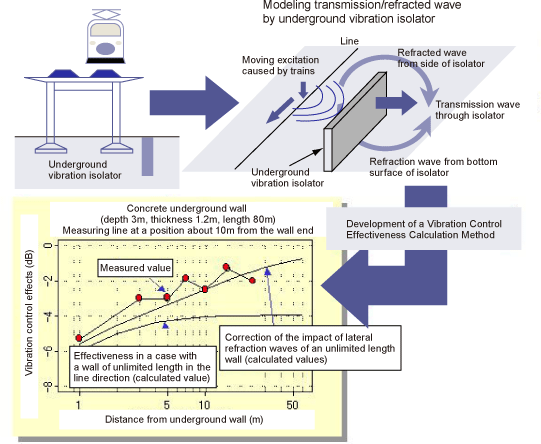
The RTRI has, therefore, constructed an evaluation model to be used to
quantitatively evaluate the relationship of the ground structure and the
ground vibration and to assess the transmission and diffraction phenomena
of the waves produced by the underground wall. This model can be applied
to quantitatively calculate the vibration reduction effects with ground
structure, scale of the underground wall (depth, thickness, construction
length) and the materials (density, elastic constant, damping constant)
etc. as parameters.
This method is far simpler than the finite element method and other numerical simulations, so it is a useful technique when planning and designing an underground vibration isolator as a vibration countermeasure.