



Building analytical models that can express vibration characteristics of car body

Figure 1. Analytical model of a railway vehicle including traction link and yaw dampers
In the conventional and widely used flexural vibration analytical model, the car body is modeled as an Euler-Bernoulli beam supported elastically in the vertical direction. In this model, the vertical vibration of car body is considered the result of vertical excitation through primary and secondary suspensions (axle springs and air springs) caused by vertical track irregularities.
However, it has been shown that longitudinal force transmitted through traction links and yaw dampers also causes the vertical flexural vibration of car body. We, therefore, have built a model including the degree of freedoms in the longitudinal direction and the effects of traction links and yaw dampers.
We also have shown that modern lightweight vehicles have complex vibration mode shapes such as the roof and floor deform different shape and/of phase. These complex vibration modes, which cannot be expressed by a simple beam model, often worsen the ride comfort. To treat such vibration as simply as possible, we are developing a three-dimensional vibration model, which consists of combination of elastic plates and beams.
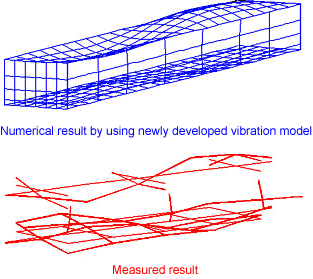
Figure 2. Natural mode shapes

