
DIASTARS
Dynamic Interaction Analysis for Shinkansen Train And Railway Structures
DYNAMIC INTERACTION ANALYSIS
FOR SHINKANSEN TRAIN AND RAILWAY STRUCTURES
Analysis Program
Dynamic Interaction Analysis for Shinkansen Train And Railway Structures (DIASTARS) has been developed to be used for detailed study using the dynamic interaction of Shinkansen trains and railway structures.
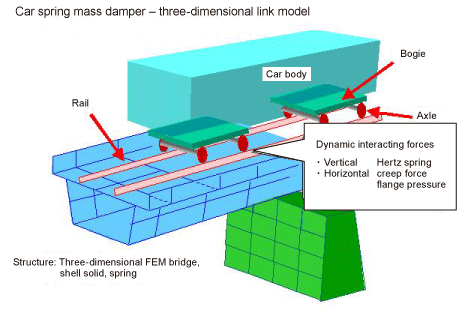
DIASTARS models a vehicle by treating it as a three-dimensional mass point,
car body, bogie frame, and axle, and linking these with springs and dampers.
Between wheels and rails, the contact point and angle of attack are obtained
considering the geometric shape of both wheels and rail, to calculate their
interaction force.
Specifically, under the vertical constitutive law, the contact force of the wheels and rail is evaluated using Hertz's contact spring, at the same time as the jumping from the rails of the wheels can also be considered.
Under the horizontal constitutive law, in a case where the distance from the wheel flange to the rail is below the joint gap, creep force at a tangent to their contact surfaces, and in a case where the wheel flange is in contact with the rails, the contact force (flange pressure) produced by the rail tilting spring respectively act in the direction of the normal line of the contact surface.
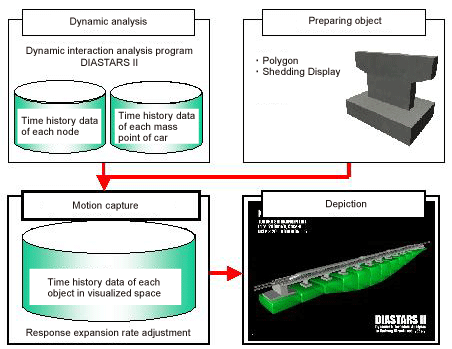
Visualizing Numerical Analysis Results
During numerical analysis, the time history data constantly increases in tiny time increments, so that it is often difficult to get a bird's eye view of all analysis results in order to correctly understand the phenomenon. Therefore, RTRI has constructed a visualization system using existing CG technology.
Specifically, this system performs the processes—preparation of vehicles,
structures, and other objects, the arrangement of the objects in visible
space, camera settings, light source designation, rendering, image compression
etc.—by combining a number of existing modules, and these existing
modules are supplemented by modules that perform motion capture of analysis
results, its conversion to visualized space coordinates, and adjustment
of the expansion rate of the response.