
RTRI Hosts 38th Annual Conference
October 23, 2025
Railway Technical Research Institute
The Railway Technical Research Institute (RTRI) successfully held the 38th Annual Conference, titled “Sophistication of Core R&D Technologies—Creating Sustainable Railway Systems.”
The event commenced with a welcome address from Dr. Masao Mukaidono, Chairman of RTRI, and featured six presentations alongside one special proposal. Approximately 300 participants attended, including those from railway operators, government agencies, universities, and private companies.
1. Time and Date: From 1:00 PM to 5:20 PM on Wednesday, October 22, 2025
2. Venue: Yurakucho Asahi Hall (Yurakucho, Chiyoda-ku, Tokyo)
3. Summary of Lectures
■ Special Lecture
“Railway and Mobility as Physical AI Systems”
Professor Kimihiko Nakano, Director of Harmonic Mobility Research Center (ITS Center), Institute of Industrial Science, The University of Tokyo
Professor Nakano discussed how core railway technologies are fundamentally grounded in physics, and emphasized the increasing necessity of artificial intelligence (AI) for further sophistication, especially in light of recent technological advances. Among these, “Physical AI”— technology that can perceive, interpret, and act upon information in the physical world—is considered a key target for sophisticating railway technologies such as automatic train operation.
He cited developments in road transportation, such as the Level 4 automated bus project in the Kashiwa-no-ha area of Kashiwa City, which his laboratory has supported, to illustrate both technological progress and the ongoing challenges. Specifically, he pointed out the complexity of creating technologies that ensure both safety and smooth operation while maintaining alignment with legislation, such as the Road Traffic Act.
Professor Nakano further explained that, in order to achieve autonomous driving that simulates human operation, AI must be capable of making decisions; however, there remains the issue that AI cannot serve as a legal entity responsible for its actions. For the implementation of AI with advanced decision-making capabilities, it is necessary to consider not only technical aspects, but also other issues such as changes in laws, rules, and the environment—including Ethical, Legal, and Social Issues (ELSI).
■ Keynote Lecture
“Sophistication of Core R&D Technologies—Creating Sustainable Railway Systems”
Dr. Masamichi Sogabe, Executive Director, RTRI
The railway industry is currently undergoing a period of major transformation in response to increasingly serious, evident, and complex social issues, as well as the rapid progress of technical innovation. In response, RTRI launched a new master plan, “RESEARCH 2030—Creating Sustainable Railway Systems,” in fiscal year 2025, in which resources are intensely allocated to the core R&D technologies. Through this, RTRI is advancing the sophistication of these technologies with the aim of realizing the ideal state of sustainable railways in the future.
The core R&D technologies, which serve as the driving force for pursuing the essence of railway issues and their solutions, are highly versatile, and generate common benefits for the entire railway industry.
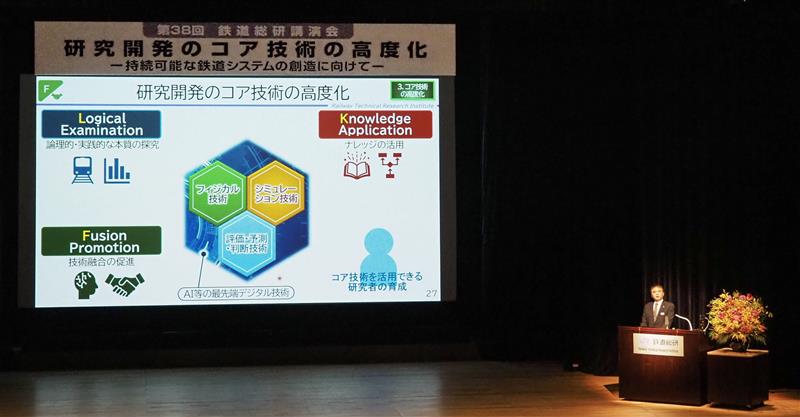
At this year’s Annual Conference, we presented three key strategic directions for sophisticating our core technologies:
(1) Pursuing the essence of railway issues through logical and practical approaches
(2) Promoting integration across different technical fields
(3) Leveraging collective knowledge to accelerate solutions
Specifically, RTRI is working to sophisticate all the core R&D technologies—such as physical, simulation, and evaluation technologies—that support railway R&D. By adopting digital twins and AI and collaborating with external organizations, RTRI accelerates this progress. In addition, RTRI is building a framework to make the industry’s collective knowledge highly and effectively available, further improving compatibility with AI and aiming for higher quality in research outcomes.
RTRI is committed to contributing its technical expertise to create sustainable railway systems and to transform railways into a foundation that supports a sustainable society.
■ Lectures
“Sophistication of Core R&D Technologies in the Technical Field of Vehicle and Electrical Systems”
Dr. Tadao Takigami, Director, Head of Vehicle Technology Division, RTRI
In the field of vehicle and electrical systems, I presented examples of initiatives being promoted by RTRI to sophisticate core technologies aimed at improving the reproducibility of real phenomena through unique testing equipment, providing logically grounded evidence based on simulation, and accelerating the resolution of cross-disciplinary challenges through the integration of different technical fields. I also highlighted efforts with an eye toward practical application, such as proposing new train control systems to promote the spread of automatic train operation and supporting the development of technical standards for hydrogen fuel cell vehicles. RTRI will continue to contribute to the creation of a sustainable railway system through further sophistication of these core technologies.
“Sophistication of Core R&D Technologies in the Technical Field of Track Structures and Components”
Dr. Toshiya Tadokoro, Director, Head of Structures Technology Division, RTRI
In the field of track structures and components, I presented how RTRI has accumulated expertise and lessons learned from accidents and disasters and has applied its research outcomes to society by improving and systematizing technologies related to safety and maintenance. To further formalize this experiential knowledge and promote its social implementation, RTRI has been utilizing various core technologies to accelerate and streamline its R&D activities. In the presentation, I introduced examples of how these core technologies are being applied within RTRI, as well as current initiatives to further sophisticate them. Through the continued sophistication of its core technologies, RTRI aims to improve railway safety and achieve labor saving in maintenance.
“Sophistication of Core R&D Technologies in the Technical Field of Human Science”
Mr. Hiroharu Endo, Director, Head of Human Science Division, RTRI
In the field of human sciences, RTRI has been promoting the application of core technologies focused on safety and comfort evaluation techniques that take human factors into account, with the aim of preventing human error–related accidents, mitigating damage in the event of accidents, and improving passenger services. Looking ahead, amid the wider adoption of autonomous train operation and the ongoing retirement of skilled workers, RTRI aims to further sophisticate its core technologies by integrating them with cutting-edge technologies and leveraging its accumulated knowledge on safety and comfort, thereby contributing to the realization of safe, secure, comfortable, and sustainable railway systems.
“Increases in the Speed of the Shinkansen and the Sophistication of Core R&D Technologies in the Technical Field of Aerodynamics”
Dr. Sanetoshi Saito, Principal Researcher, Environmental Engineering Division, RTRI
In the field of aerodynamics, RTRI has been utilizing core technologies, including experimental and simulation techniques, to address one of the key challenges accompanying the increase in Shinkansen speed—maintaining the surrounding environment—and to elucidate and resolve various issues arising from aerodynamic phenomena. I presented specific examples illustrating how RTRI is applying these core technologies. RTRI aims to further sophisticate its core technologies to elucidate railway-specific phenomena and develop new countermeasures in this field, where such phenomena are particularly prevalent.
■ Proposal
“Sophistication of Core R&D Technologies for the Future of Railways”
Dr. Yoshitaka Murono, General Director, Research and Development Promotion Division, RTRI
Railways are currently experiencing a period of profound transformation and are confronted with a diverse array of challenges. The driving force for overcoming these challenges lies in RTRI’s core R&D technologies, whose sophistication serves as the key to creating sustainable railway systems.
In response, RTRI is promoting three main initiatives:
(1) Sophisticating individual core R&D technologies—such as physical and simulation technologies—by making full use of its unique test facilities and large-scale computing systems
(2) Accelerating the sophistication of core technologies by integrating RTRI’s core R&D technologies with cutting-edge digital technologies such as AI, core R&D technologies from other industries, and manufacturing technologies from manufacturers
(3) Enhancing the quality of core technologies by collecting, accumulating, and effectively utilizing railway-specific knowledge
These core R&D technologies are valuable assets shared by the entire railway industry. By jointly preserving, developing, and evolving them, RTRI aims to contribute to the realization of sustainable railways that will, in turn, support a sustainable society.
* You can see all the photos and figures in the PDF file above.