
R&D
Research and Development

News
-
 Vehicle Technology Division
Our division is composed of Vehicle Dynamics, Vehicle Noise and Vibration, Vehicle and Bogie Parts Strength, Hydrogen and Sustainable Energy, Traction Systems, and Braking Systems. Making solutions for problems concerning vehicle structure and control is our mission to progress R&D to the next generation.
-
 Structure Technology Division
Structures Technology division is composed of five laboratories: Concrete Structures, Steel & Hybrid Structures, Foundation & Geotechnical Engineering, Tunnel Engineering, and Architecture. Research and development related to design and maintenance of structures and buildings, earthquake resistant, etc., are progressed.
-
 Power Supply Technology Division
We are engaged in research and development on a new railway power supply system apposite to the 21st century. Railway power supply system is a technology to provide a stable power to electric rolling stocks; as our research fields: power conversion at substations, feeding system, structural design and materials of overhead contact line system, and their measurement and maintenance.
-
 Track Technology Division
Our division is composed of Track Structures & Components, Track Structures & Geotechnology, Track Geometry & Maintenance, and Rail Welding. We are developing the hardware and the software about railway track technologies, which correspond to needs of railway companies, for "improvement of safety", "speeding-up", "efficiency of maintenance", "cost reduction" and "reduction of noise and vibration". Also, projects of technical criteria and international standard in railway track are progressed.
-
 Disaster Prevention Technology Division
Our division is composed of Meteorological Disaster Prevention, Geo-hazard & Risk Mitigation and Geology. Prevention of natural disasters along railway due to raining, strong wind, snow, and weathering is our mission. In addition, researches related to a ground environmental problem are progressed such as assessment and evaluation technology related to geographical features, geology, and ground water and ground vibration by train running.
-
 Signalling and Operation Systems Technology Division
The Signalling and Operation Systems Technology Division is composed of three laboratories of Signalling Systems, Train Control Systems, and Transport Operation Systems. Our division conducts research and development on signalling safety and train control systems, both essential for ensuring safe and stable railway transport. Additionally, the division explores operations planning and management, typically including timetables, vehicles, and crew scheduling. Moreover, to establish innovative railway systems in the future, we are actively involved in research and development activities that integrate Information and Communication Technologies (ICT) and other cutting-edge digital technologies with existing railway-specific technologies pertaining to safety and railway operations.
-
 Information and Communication Technology Division
The Information and Communication Technology Division consists of three laboratories: 'Information Analytics', 'Image Analysis' and 'Telecommunications and Networking'. Cross-disciplinary research and development is carried out with the aim of innovating railway systems through digital technology, using data analysis in various areas of railway systems, the use of sensors such as cameras and LiDAR and AI technology, and the latest communication technologies such as 5G and Beyond 5G.
-
 Materials Technology Division
Material Technology Division deals with the development and the evaluation of the various materials used in the railway system. For that purpose we also examine the methods of the analysis necessary for understanding the mechanism of the phenomenon. Five laboratories below are working in their research field. And the division itself carries out the researches of environmental impact assessment of the railway system and new materials for railway.
-
 Railway Dynamics Division
The main subject of Railway Dynamics Division is the dynamics of the railway structures, tracks, vehicles and overhead contact lines. The main investigations are the dynamic interaction problems between railway structures, tracks and vehicles, between wheel and rail, and between pantograph and catenary. In order to propose the innovative technologies for improving performance, safety and efficiency of railway system, it is essential to carry out basic researches on such interface problems. The laboratories in Railway Dynamics Division cooperate closely with each other and also the other divisions such as Structures Technology, Track Technology, Vehicle Structure Technology and Power Supply Technology Divisions. In addition, applied researches and developments such as design and maintenance standards, new bogie structures and new track structure are carried out, enhancing the outputs of basic researches.
-
 Aerodynamics and Acoustics Division
Our division is composed of Vehicle Aerodynamics Laboratory, Heat and Air Flow Analysis Laboratory, and Noise Analysis Laboratory Environment is a serious problem for human in the 21th century so that realization of environmentally friendly railway is strongly required from society. Japanese environmental researches and countermeasures such as 300 km/h operation of Shinkansen and 500km/h operation of levitation system railway are attracted around the world. Our aim is to lead environmental countermeasures of railways in the world keeping close cooperation with other railway companies, utilizing our testing facilities such as RTRI’s Large-Scale Low-Noise Wind Tunnel and research methods that have been developed up to now.
-
 Human Science Division
The Human Sciences Division consists of three laboratories: Safety Psychology, Ergonomics, and Comfort Science and Engineering. We are responsible for all human factors-related research and development aimed at improving railway safety and comfort. In addition, the department utilizes insights from human sciences to provide technical guidance for aptitude testing and support safety initiatives.
-
 Advanced Superconductivity Technology Division
Maglev Systems Technology Division is composed of three laboratories (Electromagnetic Systems, Cryogenic Systems, and Applied Superconductivity) and Yamanashi Maglev Test Center. Our division focus on research and development of Maglev and superconductivity.
In the development of superconducting maglev technology, basic running tests using test vehicles had been conducted on the Miyazaki Maglev Test Line (length: about 7 km) until 1996. In 1997, running tests on Yamanashi Maglev Test Line (length: 18.4 km) started in collaboration with JR Central. Now, on the basis of the basic technology development plan approved by the Minister of Land, Infrastructure, Transport and Tourism, running tests have been continued on the Yamanashi Maglev Test Line which was extended to 42.8 km in August 2013. We are conducting research on ground coils and vehicle dynamics of Maglev. In addition to the running tests, we are promoting applications to conventional railways such as linear rail brakes and non-contact power supply systems.
In superconducting technology, we are fabricating and evaluating high temperature superconductors. As applications of superconductivity, we are developing superconducting feeder systems and power storage systems aiming at decarbonization. -
 Center for Railway Earthquake Engineering Research
In massive earthquake, the risk of disaster tends to be wide and complicated. To realize safer and more secure railway, it is important to summarize resources about seismic design, seismic diagnosis, earthquake countermeasures, and early warning system. Our mission is to be only one base of railway earthquake engineering in Japan.
Our division is composed of three laboratories, Seismic Data Analysis, Soil Dynamics and Earthquake Engineering, and Structural Dynamics and Response Control.
About research

Results of research

Research and Development related

News Release of "R&D"
-
 June 30, 2026NEW
R&D
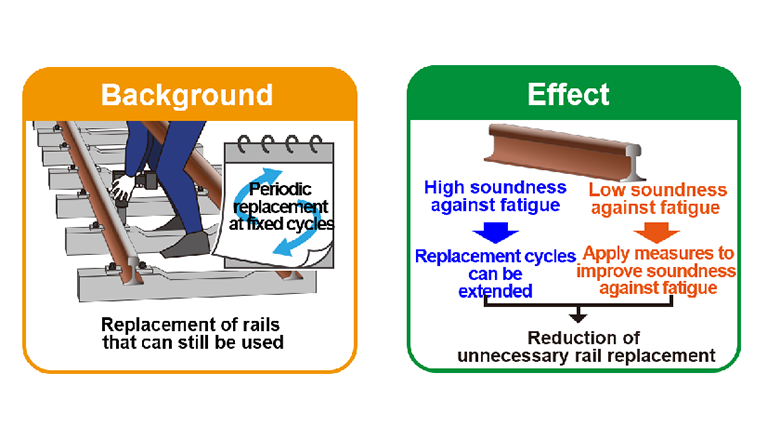
RTRI Develops a Method for Determining Rail Replacement Cycles Based on Evaluation of Rail Soundness against Fatigue
June 30, 2026NEW
R&D
RTRI Develops a Method for Determining Rail Replacement Cycles Based on Evaluation of Rail Soundness against Fatigue
-
 June 04, 2026NEW
R&D
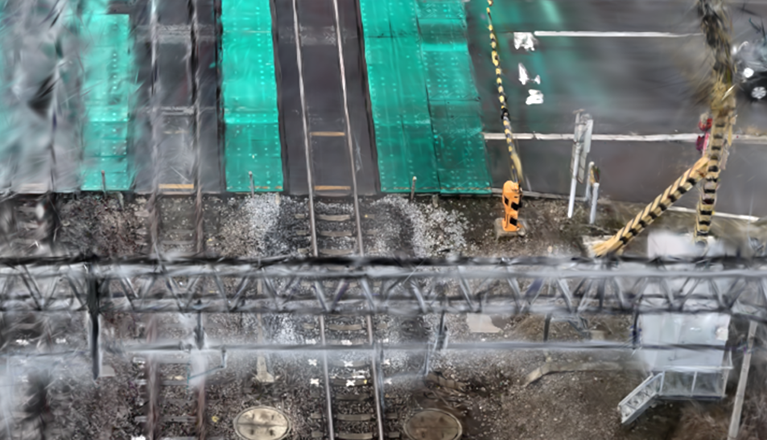
RTRI Develops Method for Constructing 3D Track Space from Camera Images
June 04, 2026NEW
R&D
RTRI Develops Method for Constructing 3D Track Space from Camera Images
-
 April 20, 2026NEW
R&D
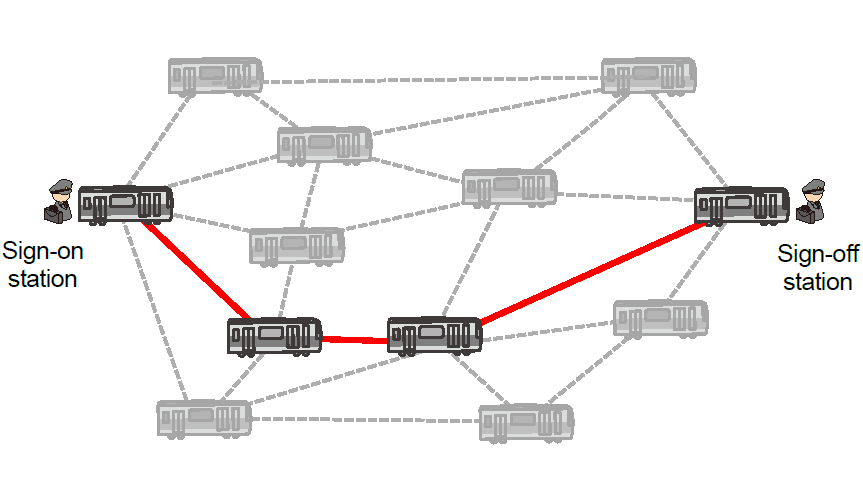
RTRI Develops Automated Method for Generating Crew Schedules
April 20, 2026NEW
R&D
RTRI Develops Automated Method for Generating Crew Schedules