
20. Degradation Prediction Method for Traction Lithium-Ion Batteries
Vehicles equipped with traction lithium-ion batteries offer advantages such as improved energy efficiency. However, reducing battery replacement costs remains a challenge due to the high cost of the batteries. Degradation of lithium-ion batteries is characterized by the capacity fade and internal resistance increase, and these indicators must be predicted to develop efficient replacement plans. However, no practical degradation prediction method has been established for these batteries that are subject to frequent charge and discharge cycles.
To address this issue, the complex charge-discharge history associated with actual vehicle acceleration and deceleration was converted into equivalent simple charge-discharge cycles. Also, fundamental charge-discharge tests were conducted to determine the parameters required for battery degradation prediction. This cycle aging model, accounting for repeated charge-discharge cycles, was combined with an already-developed calendar aging model, accounting for surrounding conditions, which lead to development of a degradation prediction method (Fig. 1).
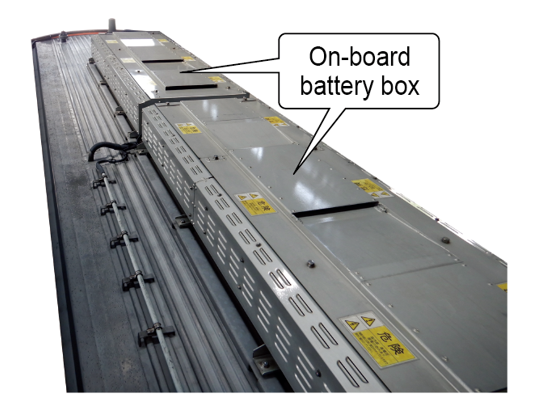
The proposed equations were verified using on-board batteries for a diesel-hybrid vehicle (Fig. 2) over approximately three years of operation. As a result, the differences from measured values were 3.7% for the capacity fade and 3.4% for the internal resistance increase, demonstrating practical prediction accuracy (Fig. 3). By inputting future operating conditions of the battery (e.g., temperature and SOC transitions), this method provides predicted values of capacity and internal resistance. By replacing batteries as late as possible based on remaining useful life estimated from predicted values, replacement costs can be reduced, thereby promoting the deployment of energy-efficient battery powered vehicles.


Other Contents
- 20. Degradation Prediction Method for Traction Lithium-Ion Batteries
- 21. CO2 Emissions Calculation Method for Rail Freight Transport
- 22. Geopolymer Concrete Containing By-products from Shinkansen Rolling Stock as Raw Materials
- 23. Method for Assessing Train Set-specific Wheel Tread Conditions Using Continuous Remote Monitoring of Wayside Noise
- 20. Degradation Prediction Method for Traction Lithium-Ion Batteries
- 21. CO2 Emissions Calculation Method for Rail Freight Transport
- 22. Geopolymer Concrete Containing By-products from Shinkansen Rolling Stock as Raw Materials
- 23. Method for Assessing Train Set-specific Wheel Tread Conditions Using Continuous Remote Monitoring of Wayside Noise