
21. CO2 Emissions Calculation Method for Rail Freight Transport
Users of railway freight transport are required to report CO2 emissions, and there is a need for a method to estimate energy consumption simply and accurately. The conventional activity-based calculation method, which is called the ton-kilometer method or ton-mile method and uses the average energy consumption per unit transported volume, cannot consider for operating conditions such as train timetables and routes, and therefore cannot properly evaluate differences among trains.
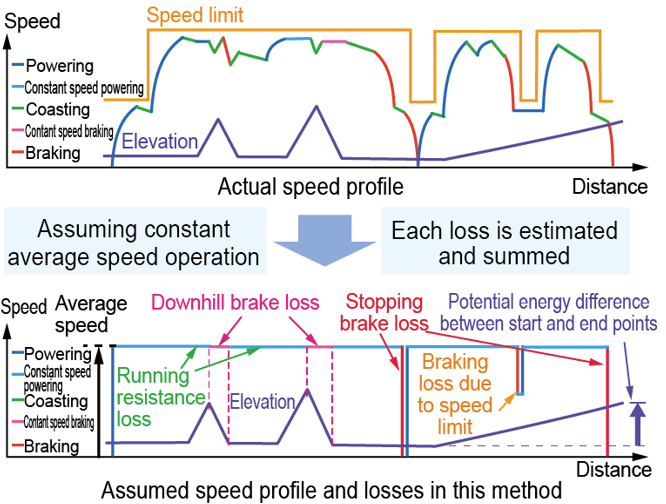
In this study, we developed a “energy consumption estimation method for long-distance trains” that can easily calculate energy consumption according to train operating conditions. This method targets trains such as freight trains that operate over long distances mainly by passing through stations, and estimates energy consumption by assuming constant average speed operation rather than reproducing detailed speed profiles like in running simulations. The method calculates energy losses due to braking under downhill gradients and speed restrictions specific to each railway route, using route indices extracted in advance from route data, and enables simple and highly accurate estimation of energy consumption by aggregating these losses (Fig. 1).
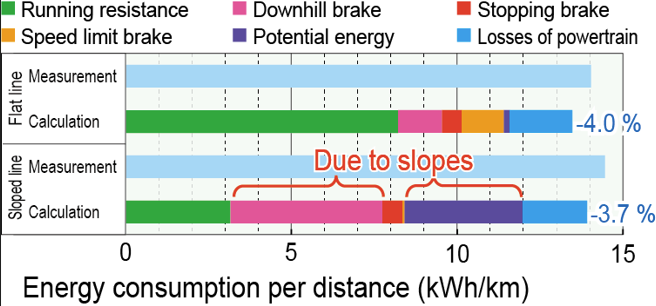
For accuracy validation, 12 freight train services with various operating conditions were selected from across Japan (total travel distance: approximately 10,000 km), taking into account train characteristics such as railway track gradients and average speeds. The estimated energy consumption for each train was compared with measured average values, confirming an error of approximately 10% (Fig. 2).
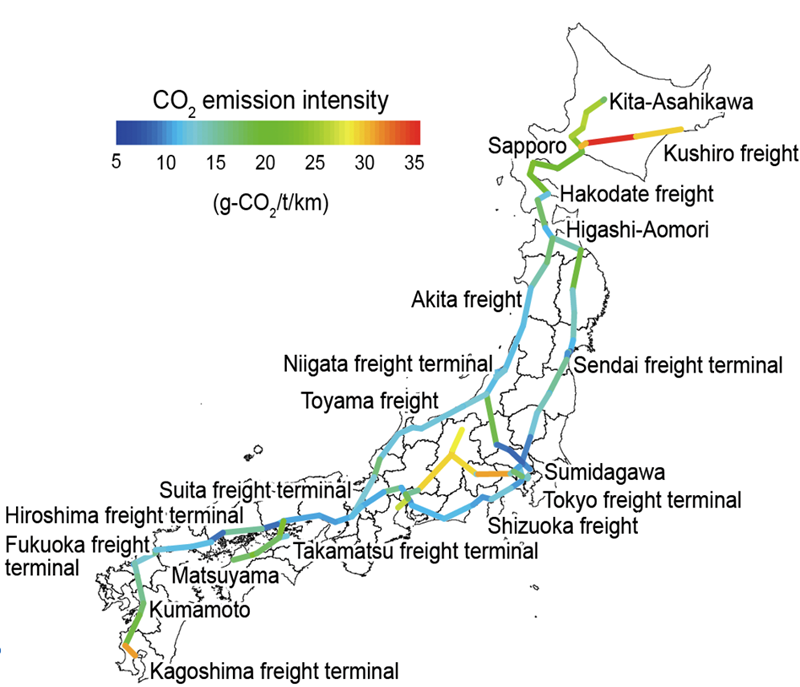
The study confirmed that this method enables the calculation of energy consumption according to train operating conditions, which cannot be considered in conventional approaches, and allows CO2 emissions to be calculated on a nationwide scale (Fig. 3). Users of railway freight transportation can utilize this method to estimate CO2 emissions.
Other Contents
- 20. Degradation Prediction Method for Traction Lithium-Ion Batteries
- 21. CO2 Emissions Calculation Method for Rail Freight Transport
- 22. Geopolymer Concrete Containing By-products from Shinkansen Rolling Stock as Raw Materials
- 23. Method for Assessing Train Set-specific Wheel Tread Conditions Using Continuous Remote Monitoring of Wayside Noise
- 20. Degradation Prediction Method for Traction Lithium-Ion Batteries
- 21. CO2 Emissions Calculation Method for Rail Freight Transport
- 22. Geopolymer Concrete Containing By-products from Shinkansen Rolling Stock as Raw Materials
- 23. Method for Assessing Train Set-specific Wheel Tread Conditions Using Continuous Remote Monitoring of Wayside Noise