
23. Method for Assessing Train Set-specific Wheel Tread Conditions Using Continuous Remote Monitoring of Wayside Noise
From the perspective of compliance with environmental quality standards and environmental conservation for Shinkansen wayside noise, it is desirable for railway operators to quantitatively assess the actual noise levels and their temporal variations. Wheel reprofiling is widely recognized as an effective countermeasure for reducing rolling noise, one of the major sources of wayside noise. However, because rolling noise characteristics depend on wheel tread conditions, accurately determining the optimal timing for wheel reprofiling remains challenging.
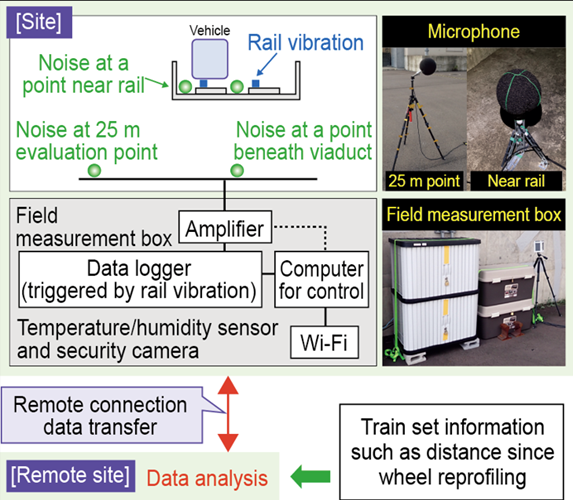
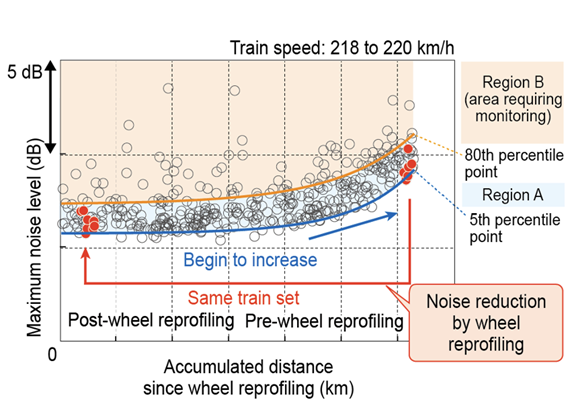
To capture the characteristics of temporal changes in wheel tread conditions associated with rolling noise generation, a monitoring method was developed that enables continuous measurement of wayside noise at the 25 m evaluation point, which is used as a standard evaluation point for environmental quality standards, as well as at points near the rail (Fig. 1). Sound pressure and rail vibration waveforms for individual passing trains are automatically recorded by field-installed measurement equipment, remotely transmitted to an analysis center, and consolidated for analysis. By combining the long-term measurement data obtained using the proposed method with train set information such as distance covered in kilometers since wheel reprofiling, a statistical analysis was conducted on approximately 400 train passages from about 20 train sets of the same type of rolling stock. The results showed that noise levels varied among train sets even when the distance accumulated since wheel reprofiling was similar (Fig. 2). In addition, noise levels were found to exhibit an increasing trend once the accumulated distance exceeded a certain threshold (Region A in Fig. 2). It was also confirmed that wheel reprofiling after extended service reduced noise levels at the 25 m evaluation point, including rolling noise. Furthermore, quantile regression analysis of temporal changes in noise levels enabled the identification of train sets that could potentially contribute to exceedances of environmental quality standards (Region B in Fig. 2). In addition, even when measurements at the 25 m evaluation point are difficult to obtain, temporal changes in rolling noise can be assessed from noise measured directly beneath viaducts.
Since temporal changes in rolling noise reflecting wheel tread conditions can be monitored remotely, this method can be used to help determine the optimal timing of wheel reprofiling for each train set.
Other Contents
- 20. Degradation Prediction Method for Traction Lithium-Ion Batteries
- 21. CO2 Emissions Calculation Method for Rail Freight Transport
- 22. Geopolymer Concrete Containing By-products from Shinkansen Rolling Stock as Raw Materials
- 23. Method for Assessing Train Set-specific Wheel Tread Conditions Using Continuous Remote Monitoring of Wayside Noise
- 20. Degradation Prediction Method for Traction Lithium-Ion Batteries
- 21. CO2 Emissions Calculation Method for Rail Freight Transport
- 22. Geopolymer Concrete Containing By-products from Shinkansen Rolling Stock as Raw Materials
- 23. Method for Assessing Train Set-specific Wheel Tread Conditions Using Continuous Remote Monitoring of Wayside Noise