24. High-Strength Shinkansen Contact Wire Splice for Emergency Restoration after Disasters
When a contact wire is broken or damaged, such as by a major earthquake, service is restored by joining the contact wire and partially replacing the damaged section. On Shinkansen lines, however, train speeds through the joint location have conventionally been restricted to levels comparable to those on conventional lines (e.g., 110 km/h) because the additional mass at the joint may increase contact loss and fatigue fracture during high-speed operation. Since high-speed operation cannot be restored until permanent restoration involving replacement of the entire tension length is completed, service rapidity has historically been compromised for prolonged periods, particularly when the affected area is extensive.
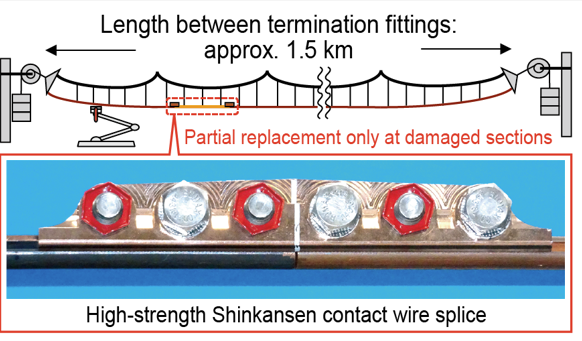
To enable high-speed operation through contact wire joints, a contact wire splice for Shinkansen high-strength contact wires was developed (Fig. 1). By adopting a copper alloy for the first time in domestic overhead contact line fittings and optimizing its detailed geometry, the developed splice reduced the increase in overhead contact line mass at the joint to 0.9 kg (compared with 3.9 kg for a conventional design), thereby achieving both reliable electrical and mechanical connection performance for high-strength contact wires and high-speed passage capability.
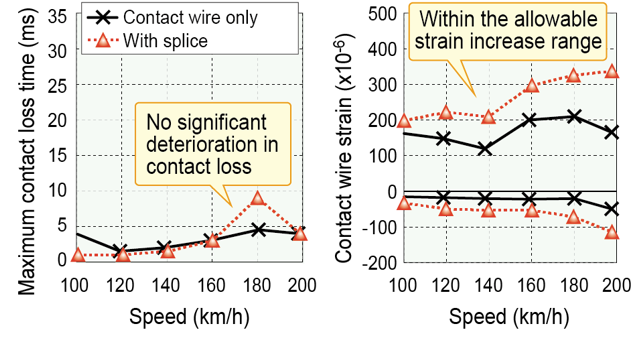
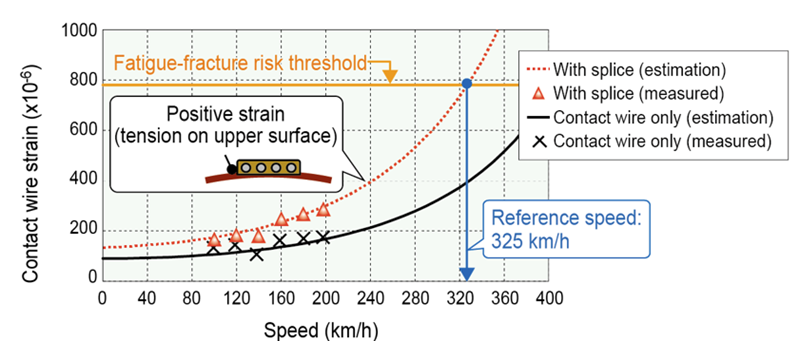
To evaluate the maximum applicable speed of the developed splice, full-scale in-house tests were conducted, which demonstrating its suitability for train passing speeds of up to 200 km/h (Fig. 2). In addition, theoretical analysis was conducted to estimate contact wire strain near the splice, an indicator of fatigue fracture, indicating the potential applicability of the splice at train passing speeds of up to 325 km/h (Fig. 3).
The developed splice can be applied to a wide range of Shinkansen contact wires, including both high-strength and conventional types, and makes it possible to increase the permissible train passing speed during emergency restoration following disasters from the conventional 110 km/h to 200 km/h or higher. Future work will include field testing on Shinkansen lines to evaluate the applicability of the developed splice at train passing speeds exceeding 200 km/h.