26. Method for Automatically Generating Train Rescheduling Plans to Minimize the Number of Delayed Passengers
During disruptions to train services, train rescheduling operations are performed to modify the timetable by combining measures such as changes to train departure order and other operational actions. In such situations, it is necessary to quickly determine and implement appropriate rescheduling actions while considering not only train delays but also passenger impacts. This places a significant burden on dispatchers, and the process relies heavily on their experience, which remains a major challenge.
To overcome this challenge, the number of passengers with delayed arrival at their destination stations (the number of delayed passengers), defined as an indicator of passenger impact, was set as an evaluation value, and a method was developed to automatically generate train rescheduling plans that minimize this value. In the proposed method, an "affected passenger count" is calculated to represent the number of passengers whose arrival at their destination stations is delayed by a train delay at a given location. Rescheduling actions intended to reduce delays at locations with high affected passenger counts are then evaluated. In addition, actions that temporarily worsen the evaluation value are accepted depending on the search progress, enabling the exploration of diverse train rescheduling options. Combined with a mechanism that prevents repeated selection of the same actions, the method can rapidly generate train rescheduling plans that improve the evaluation value.
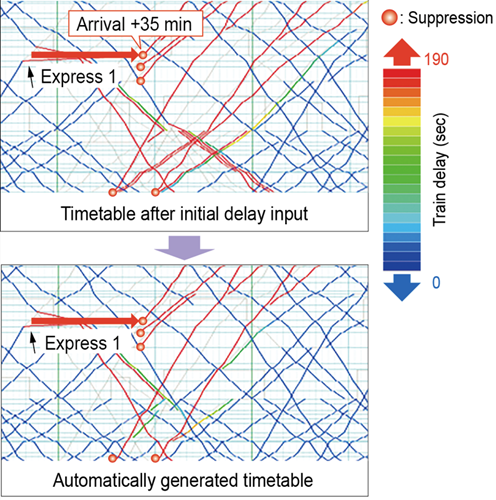
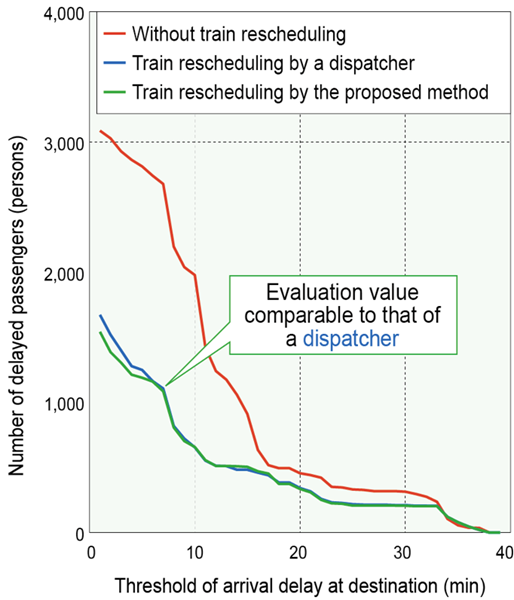
Applying the proposed method to a real-world case involving an approximately 30-minute delay on a railway line confirmed that train rescheduling plans with appropriately selected overtaking stations can be automatically generated within a computation time limit of two minutes (Fig. 1). It was also confirmed that the proposed method can generate train rescheduling plans with a number of delayed passengers comparable to that achieved by a dispatcher (Fig. 2). Furthermore, it was confirmed that the number of delayed passengers could be reduced even in a hypothetical delay scenario assuming the morning peak period with a high train frequency.
By integrating the proposed method into a train operation control system, train rescheduling that reduces the number of delayed passengers becomes possible, contributing to labor savings and reducing reliance on dispatcher expertise in train rescheduling.