25. Method for Estimating Station Passenger Volumes on Regional Railways
To evaluate investments and operational measures for regional railways, it is necessary to understand the daily usage patterns at individual stations. However, because many regional railways have not yet introduced automatic ticket gates or smart card systems, accurate and continuous monitoring requires on-site boarding and alighting surveys. In general, increasing the duration of boarding and alighting surveys increases the amount of available data and is expected to improve the accuracy of station passenger volume estimates, but it also increases survey costs.
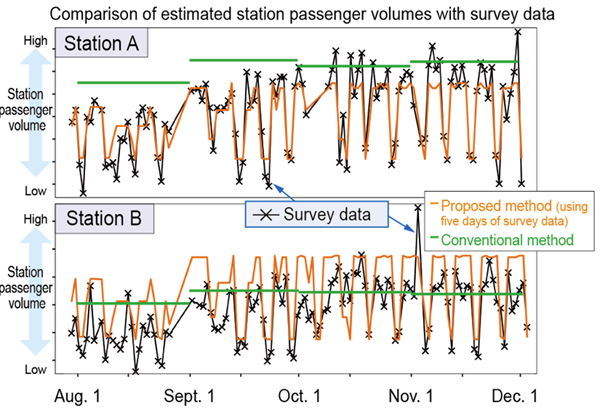
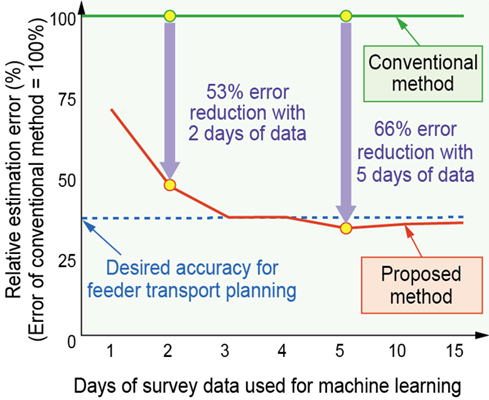
To address this issue, a machine learning model was developed to estimate daily station-level passenger volumes by combining monthly ticket sales data and crew-reported passenger count data routinely collected by railway operators with a small amount of boarding and alighting survey data (Fig. 1). In addition, the number of days of boarding and alighting survey data used for model development was varied to compare estimation accuracy, and an indication of the number of survey days needed to achieve the desired level of accuracy was provided. The developed model was applied to estimate passenger volumes at 13 stations on a railway line. Compared with the conventional method based on aggregated monthly ticket sales data, estimation error was reduced by 53% when two days of boarding and alighting survey data were used, and by 66% when five days of survey data were used (Fig. 2). Based on previous studies and national guidelines, the proposed method provides estimates with sufficient accuracy for application in the planning of feeder transport services (i.e., terminal transport between stations and destinations).
The proposed method enables railway operators to understand station usage patterns with minimal survey effort and can be applied to quantitative decision-making for measures such as train service frequency, train set size, feeder transport modes and service frequency, and investment in station facilities.