
1. Railway Earthquake Disaster Prevention Method Using Distributed Acoustic Sensing (DAS)
Railway operators use data from seismometers installed along railway lines at intervals of several tens of kilometers to enable the rapid issuance of earthquake early warnings and support decision-making on inspections and the resumption of train operations after an earthquake. However, since these seismometers are installed at relatively wide intervals and provide only discrete measurement points, they cannot capture the ground motion along the railway in sufficient detail. As a result, this can lead to estimation errors in warning decisions and prolong the time required for post-earthquake inspections and resumption of train operations.
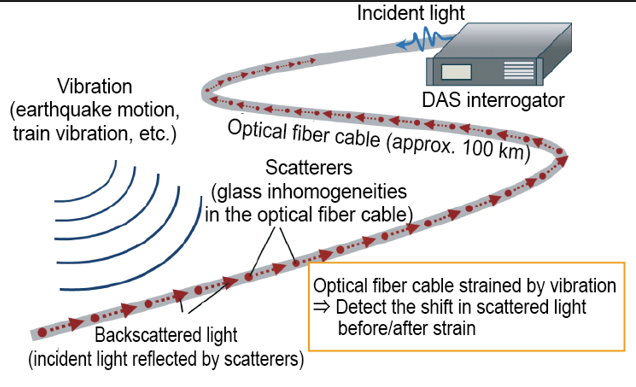
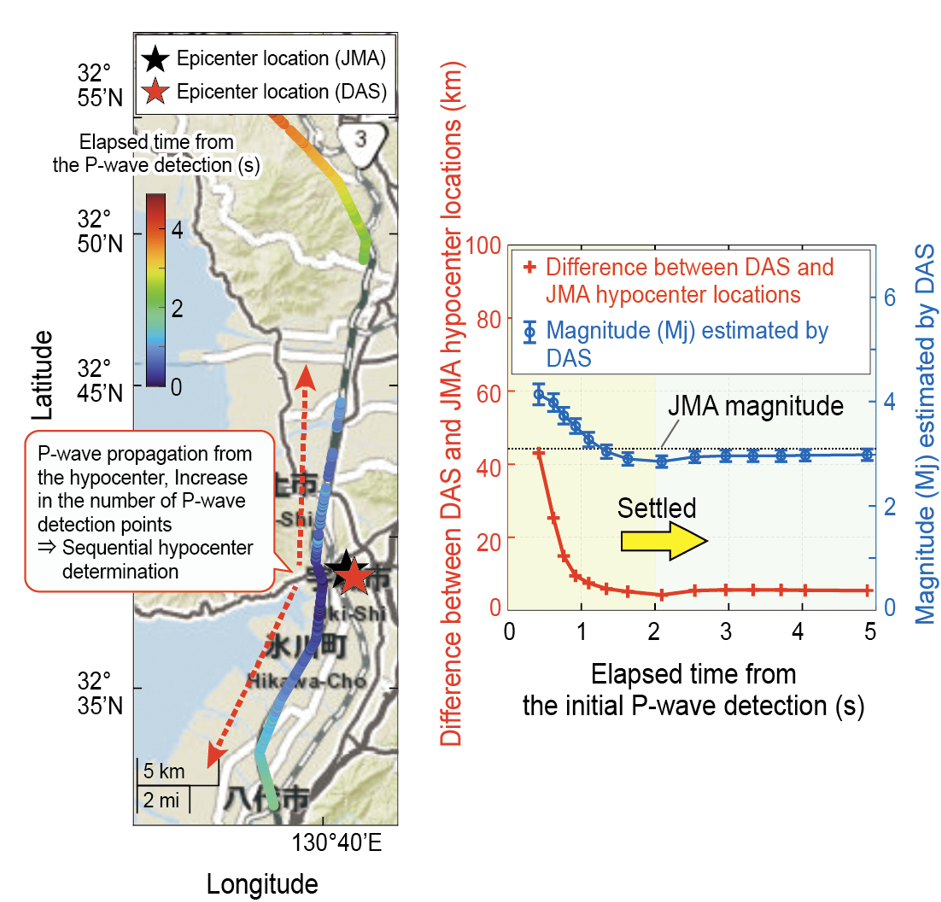
To address this issue, a method for high-density monitoring of the spatial distribution of surface earthquake ground motion along railway lines has been developed using Distributed Acoustic Sensing (DAS) technology (Fig. 1), which measures strain along optical fiber cables. This method applies DAS technology to the existing telecommunications optical fiber cables installed along railway lines. It enables accurate measurement of the ground motion by compensating for the installation conditions of the optical fiber cables (e.g., the degree of coupling to the ground) and the vibration characteristics of nearby structures. Furthermore, a method was developed for accurately estimating seismic parameters (including the hypocenter and magnitude) by sequentially determining the hypocenter location using a large number of wave arrival times obtained from DAS measurements.
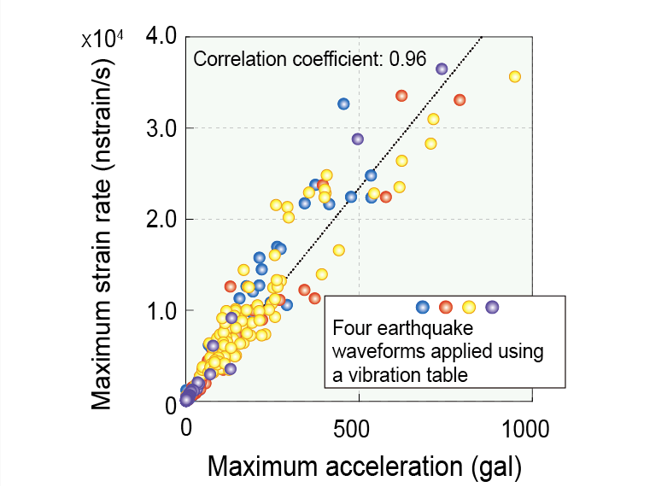
Results from large-scale vibration table tests and validation tests using existing railway optical fiber cables confirmed that the developed method can capture the distribution of earthquake ground motion at intervals of several tens of meters, ranging from weak to strong shaking equivalent to seismic intensity 6 upper on the Japan Meteorological Agency seismic intensity scale (Fig. 2). In addition, validation of the seismic parameter estimation method confirmed that, within approximately 1-2 seconds of P-wave detection, the hypocenter can be estimated with an error of less than 10 km and the magnitude with an error of approximately ±0.5 (Fig. 3).
Building on these results, we aim to further refine the developed methods using existing optical fiber cables installed along railway lines, and to conduct real-time operational testing with a prototype system, with the ultimate goal of deploying the technology in railway earthquake disaster prevention systems.
Other Contents
- 1. Railway Earthquake Disaster Prevention Method Using Distributed Acoustic Sensing (DAS)
- 2. Real-Time Spatial Earthquake Motion Estimation Using Machine Learning
- 3. Enhancement of Seismic Train-Running Safety on Viaducts Using Low-Cost Displacement-Suppression Dampers
- 4. Elucidation of Air Spring Behavior Under Large Displacements and Abnormal Conditions
- 5. Multifunctional Experiment Facility and Prediction Method for Hot Gas Layer Characteristics in Tunnel Fires
- 6. Granular Flame Retarder for Railway Seats Using a Self-Extinguishing Resin for Reducing Fire Risk
- 1. Railway Earthquake Disaster Prevention Method Using Distributed Acoustic Sensing (DAS)
- 2. Real-Time Spatial Earthquake Motion Estimation Using Machine Learning
- 3. Enhancement of Seismic Train-Running Safety on Viaducts Using Low-Cost Displacement-Suppression Dampers
- 4. Elucidation of Air Spring Behavior Under Large Displacements and Abnormal Conditions
- 5. Multifunctional Experiment Facility and Prediction Method for Hot Gas Layer Characteristics in Tunnel Fires
- 6. Granular Flame Retarder for Railway Seats Using a Self-Extinguishing Resin for Reducing Fire Risk