
5. Multifunctional Experiment Facility and Prediction Method for Hot Gas Layer Characteristics in Tunnel Fires
The hot gas layer generated during a tunnel fire contains smoke, and its behavior significantly affects evacuation safety, ventilation planning, and the placement of fire detection equipment. Therefore, it is important to understand its thermal and flow characteristics, including temperature, propagation speed, and extent of spread. However, accurately estimating the behavior of the hot gas layer in full-scale tunnels is challenging as it can be influenced by various factors, including vehicles, branch tunnels, tunnel gradients, and wind conditions.
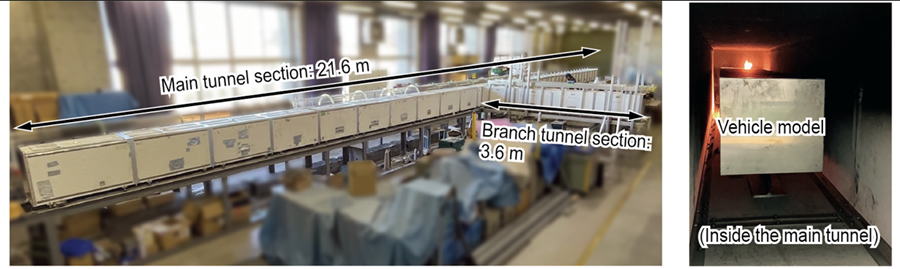
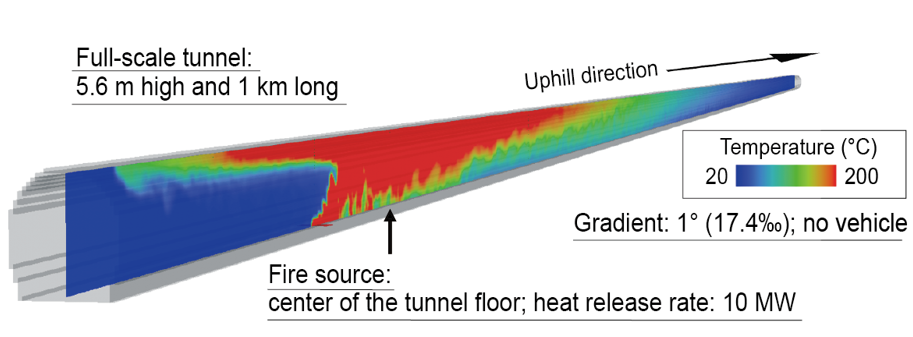
To address this issue, we developed a multifunctional model-scale experimental facility for tunnel fires (Fig. 1) at approximately one-tenth the scale of a full-scale tunnel. The facility has a wall structure capable of reproducing heat absorption characteristics nearly equivalent to those of full-scale tunnel linings. It also allows experimental conditions, including the presence of vehicles and branch tunnels, tunnel gradients, and wind conditions, to be varied and controlled. The main tunnel section is 21.6 m long, making the facility one of the few large-scale facilities of its kind worldwide. Experiments using this facility showed that the temperature rise beneath the tunnel ceiling, propagation speed of the hot gas layer, and the thickness of the hot gas layer decrease exponentially with distance from the fire source. The experiments also showed that the presence of a vehicle reduces the thickness of the hot gas layer. In addition, simulations of a full-scale tunnel were conducted (Fig. 2) using a numerical simulation method validated against the scale-model experiments results.
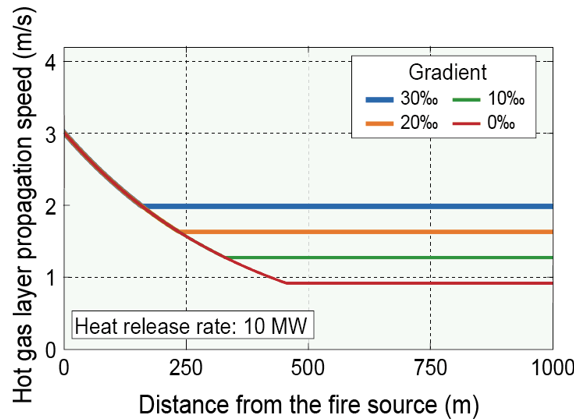
Based on detailed analyses of the model-scale experiments and numerical simulations, simplified prediction equations were developed to estimate the temperature rise, propagation speed, and thickness of the hot gas layer (Fig. 3). These equations enable railway operators to rapidly estimate the parameters needed to evaluate evacuation safety during tunnel fires, plan ventilation operation, assess the effects on connected spaces such as branch tunnels, and determine the placement of fire detection and other safety equipment. When a more detailed assessment is required for a specific tunnel or assumed scenario, we can also provide detailed predictions using our validated numerical simulation method.
Other Contents
- 1. Railway Earthquake Disaster Prevention Method Using Distributed Acoustic Sensing (DAS)
- 2. Real-Time Spatial Earthquake Motion Estimation Using Machine Learning
- 3. Enhancement of Seismic Train-Running Safety on Viaducts Using Low-Cost Displacement-Suppression Dampers
- 4. Elucidation of Air Spring Behavior Under Large Displacements and Abnormal Conditions
- 5. Multifunctional Experiment Facility and Prediction Method for Hot Gas Layer Characteristics in Tunnel Fires
- 6. Granular Flame Retarder for Railway Seats Using a Self-Extinguishing Resin for Reducing Fire Risk
- 1. Railway Earthquake Disaster Prevention Method Using Distributed Acoustic Sensing (DAS)
- 2. Real-Time Spatial Earthquake Motion Estimation Using Machine Learning
- 3. Enhancement of Seismic Train-Running Safety on Viaducts Using Low-Cost Displacement-Suppression Dampers
- 4. Elucidation of Air Spring Behavior Under Large Displacements and Abnormal Conditions
- 5. Multifunctional Experiment Facility and Prediction Method for Hot Gas Layer Characteristics in Tunnel Fires
- 6. Granular Flame Retarder for Railway Seats Using a Self-Extinguishing Resin for Reducing Fire Risk