
4. Elucidation of Air Spring Behavior Under Large Displacements and Abnormal Conditions
Air springs are key components that influence the running safety and riding comfort of railway vehicles, and are normally used within a vertical displacement range of several tens of millimeters. In contrast, during earthquakes accompanied by strong ground shaking, vehicles may undergo large motions, causing air springs to extend beyond their normal range or allowing internal air to leak. However, the characteristics of air springs under such large displacement conditions and the mechanisms of air leakage had not yet been fully understood.
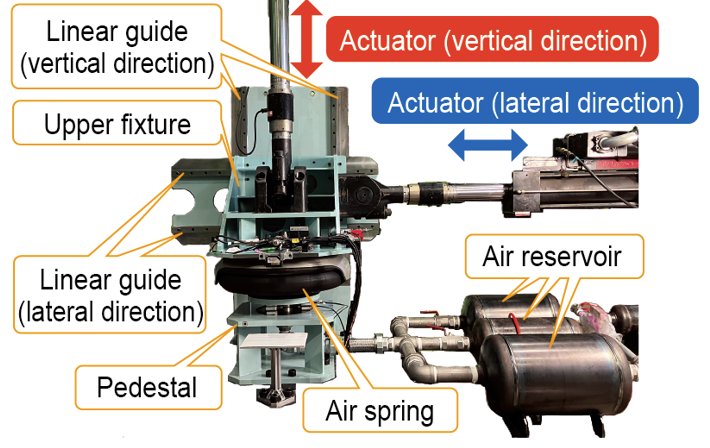
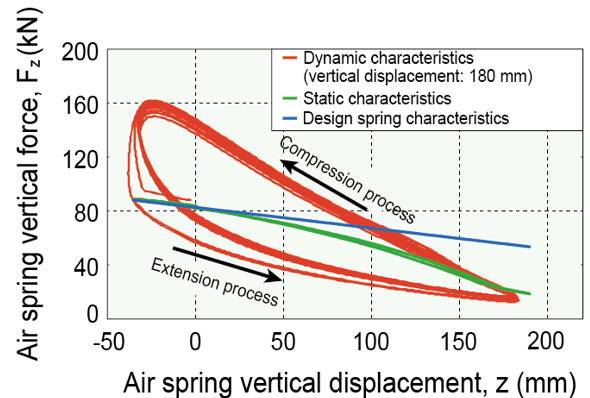
To address this issue, vibration tests of air springs were conducted using a test apparatus for civil structures capable of accommodating large displacements (Fig. 1). The test results revealed that the vertical force generated by the air spring differs significantly during the extension and compression process, exhibiting nonlinear characteristics that cannot be represented by a conventional linear spring model (Fig. 2). In addition, it was confirmed that air leakage from the air spring occurs when the self-seal mechanism, which maintains airtightness, disengages due to excessive extension.
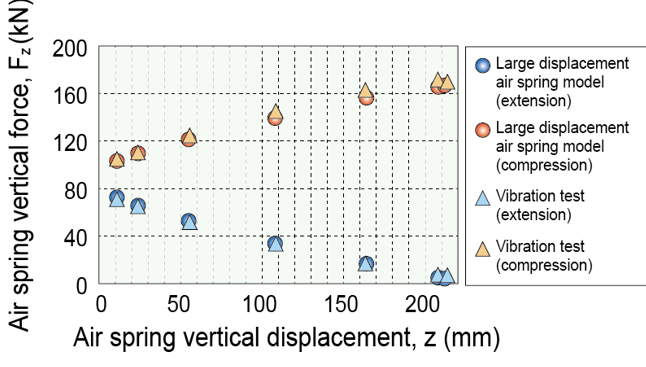
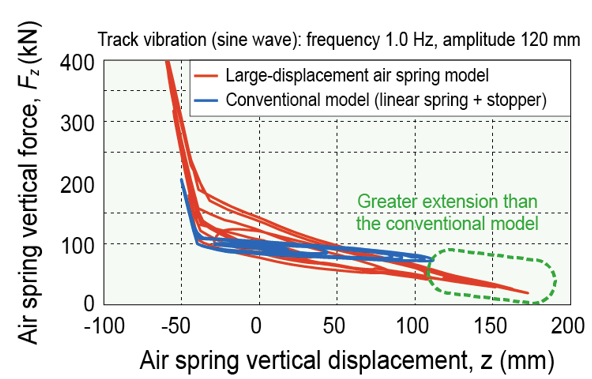
Based on these experimental findings, a new model capable of reproducing air spring behavior under large displacement conditions was proposed. Reproduction analyses of the vibration tests were conducted using the proposed model, and the results demonstrated that the large-displacement air spring model was in good alignment with the test results over a range of vibration frequencies and vertical displacement amplitudes (Fig. 3). Furthermore, by incorporating the proposed air spring model into a previously developed vehicle behavior simulation program, it became possible to evaluate earthquake-induced dynamic vehicle behavior more realistically, including for larger air spring extensions than those predicted by conventional models (Fig. 4).
The new vehicle behavior model can be used for evaluating running safety during earthquakes and for studying seismic countermeasure components.
Other Contents
- 1. Railway Earthquake Disaster Prevention Method Using Distributed Acoustic Sensing (DAS)
- 2. Real-Time Spatial Earthquake Motion Estimation Using Machine Learning
- 3. Enhancement of Seismic Train-Running Safety on Viaducts Using Low-Cost Displacement-Suppression Dampers
- 4. Elucidation of Air Spring Behavior Under Large Displacements and Abnormal Conditions
- 5. Multifunctional Experiment Facility and Prediction Method for Hot Gas Layer Characteristics in Tunnel Fires
- 6. Granular Flame Retarder for Railway Seats Using a Self-Extinguishing Resin for Reducing Fire Risk
- 1. Railway Earthquake Disaster Prevention Method Using Distributed Acoustic Sensing (DAS)
- 2. Real-Time Spatial Earthquake Motion Estimation Using Machine Learning
- 3. Enhancement of Seismic Train-Running Safety on Viaducts Using Low-Cost Displacement-Suppression Dampers
- 4. Elucidation of Air Spring Behavior Under Large Displacements and Abnormal Conditions
- 5. Multifunctional Experiment Facility and Prediction Method for Hot Gas Layer Characteristics in Tunnel Fires
- 6. Granular Flame Retarder for Railway Seats Using a Self-Extinguishing Resin for Reducing Fire Risk