
3. Enhancement of Seismic Train-Running Safety on Viaducts Using Low-Cost Displacement-Suppression Dampers
In Shinkansen rigid-frame viaducts, earthquakes can cause significant structural vibrations, resulting in displacement of the track. As a result, running safety during earthquakes may deteriorate, potentially increasing the risk of derailment. Conventional displacement suppression measures typically rely on custom-made dampers that often require specialized materials and manufacturing processes compared with standard components. As a result, rapid member replacement after an earthquake is not easy, while construction costs are high and installation is subject to significant constraints.
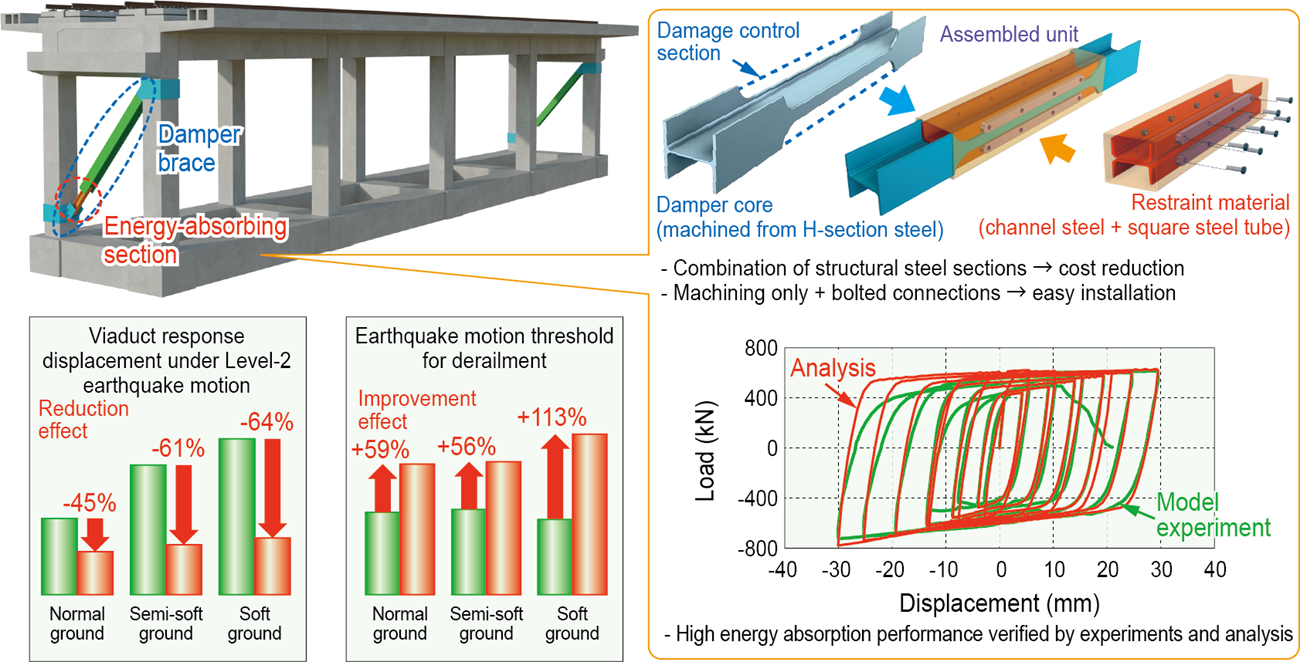
To address these challenges, we developed a low-cost displacement-control damper brace system for viaducts (Fig. 1, upper left and upper right). By combining a diagonal brace with a damper that can be fabricated through simple machining of standard H-section steel, the overall behavior of the viaduct can be controlled, thereby increasing the lateral stiffness of the viaduct efficiently. Furthermore, the use of bolt connections between structural steels, without the need for special processing or dedicated manufacturing equipment, ensures efficient on-site assembly. This enables a reduction of more than 20% in manufacturing and installation costs while maintaining performance equivalent to that of conventional systems.
The performance of the developed damper was evaluated through scaled loading tests and static nonlinear finite element analysis. Without restraint material, the damper buckles under compressive loads, resulting in a reduction in load-carrying capacity. In the developed damper, however, buckling is suppressed by the restraint material, allowing the load-displacement relationship to remain stable even under large deformations and providing high energy absorption performance against seismic loading (Fig. 1, lower right). Application of the developed damper to a standard rigid-frame viaduct was confirmed to reduce structural response displacement under a Level 2 earthquake motion and to increase the level of earthquake motion required to cause train derailment by more than 50% (Fig. 1, lower left).
The developed technology is scheduled for implementation on certain Shinkansen lines and also has the potential to be applied in other fields, including roads and buildings.
Other Contents
- 1. Railway Earthquake Disaster Prevention Method Using Distributed Acoustic Sensing (DAS)
- 2. Real-Time Spatial Earthquake Motion Estimation Using Machine Learning
- 3. Enhancement of Seismic Train-Running Safety on Viaducts Using Low-Cost Displacement-Suppression Dampers
- 4. Elucidation of Air Spring Behavior Under Large Displacements and Abnormal Conditions
- 5. Multifunctional Experiment Facility and Prediction Method for Hot Gas Layer Characteristics in Tunnel Fires
- 6. Granular Flame Retarder for Railway Seats Using a Self-Extinguishing Resin for Reducing Fire Risk
- 1. Railway Earthquake Disaster Prevention Method Using Distributed Acoustic Sensing (DAS)
- 2. Real-Time Spatial Earthquake Motion Estimation Using Machine Learning
- 3. Enhancement of Seismic Train-Running Safety on Viaducts Using Low-Cost Displacement-Suppression Dampers
- 4. Elucidation of Air Spring Behavior Under Large Displacements and Abnormal Conditions
- 5. Multifunctional Experiment Facility and Prediction Method for Hot Gas Layer Characteristics in Tunnel Fires
- 6. Granular Flame Retarder for Railway Seats Using a Self-Extinguishing Resin for Reducing Fire Risk