
27. Method for Evaluating Erosion on Embankment Slopes Induced by Rainfall
Erosion is a form of failure in which ground materials are detached by surface water, and large-scale erosion damage has been reported on railway embankment slopes due to heavy rainfall. In particular, significant slope erosion is a concern for steep embankments. However, test methods and analytical approaches for evaluating the erosion of embankment materials have not been established.
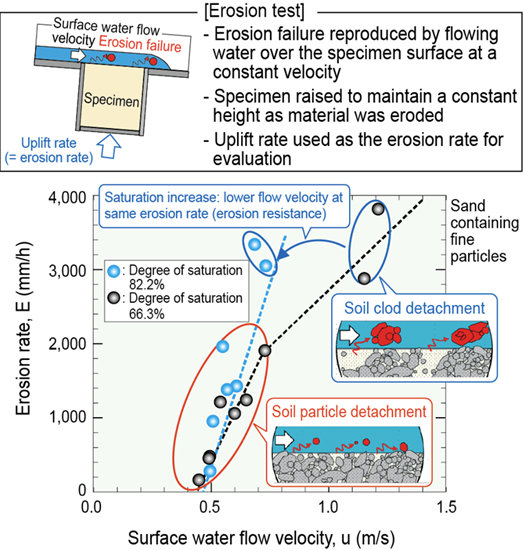
To address this issue, an erosion test apparatus capable of accounting for soil density and degree of saturation, both of which affect erosion, was developed. Using the apparatus, the relationship between surface water flow velocity and erosion rate was evaluated as a measure of erosion resistance (Fig. 1). In this test, water at a constant flow velocity is applied to the surface of a specimen composed of embankment material. The specimen is raised in response to the erosion amount, and this displacement rate is evaluated as the erosion rate. The test results showed that erosion occurs in two forms: soil particle erosion and soil clod erosion. At low flow velocities, soil particle detachment was dominant, and the influence of the degree of soil saturation on erosion resistance was found to be small. In contrast, at high flow velocities, erosion was dominated by soil clod detachment, and it was found that the flow velocity corresponding to a given erosion rate decreased as the degree of soil saturation increased due to the associated reduction in soil strength.
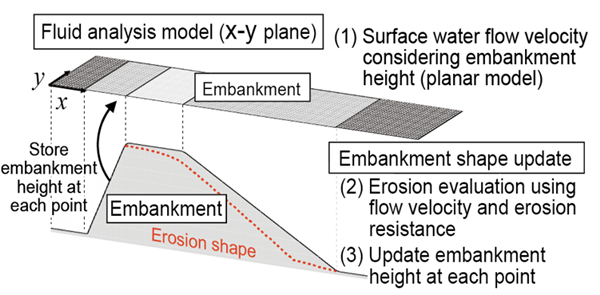
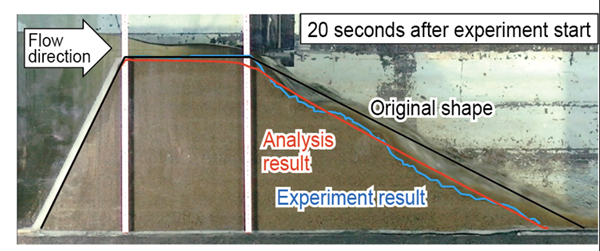
Next, a method was proposed for quantitatively evaluating erosion on embankment slopes by using the surface velocity distribution of water flowing down embankment slopes obtained from planar fluid analysis (Fig. 2) and the erosion resistance derived from the erosion test apparatus (Fig. 1). The proposed method was validated through overflow model experiments, confirming that erosion amounts varying with the degree of saturation of embankment materials, which could not previously be evaluated, can be evaluated with an average error of approximately 30% (Fig. 3).
The proposed method can be applied to the quantitative evaluation of embankment erosion during heavy rainfall, the planning of preventive measures against rainfall for existing embankments, and the selection of materials for steep embankments.
Other Contents
- 27. Method for Evaluating Erosion on Embankment Slopes Induced by Rainfall
- 28. Snow Accretion Simulation Based on a Constitutive Law for Snow Throwing by Wheels
- 29. Simulation Method for Impact Response of Track Members under Wheel Flat Conditions
- 30. Mechanism of Lift Force Variation in Shinkansen Pantograph Heads
- 31. Knee Impact Test to Assess Driver Injury Risk in Train Accidents
- 27. Method for Evaluating Erosion on Embankment Slopes Induced by Rainfall
- 28. Snow Accretion Simulation Based on a Constitutive Law for Snow Throwing by Wheels
- 29. Simulation Method for Impact Response of Track Members under Wheel Flat Conditions
- 30. Mechanism of Lift Force Variation in Shinkansen Pantograph Heads
- 31. Knee Impact Test to Assess Driver Injury Risk in Train Accidents