
31. Knee Impact Test to Assess Driver Injury Risk in Train Accidents
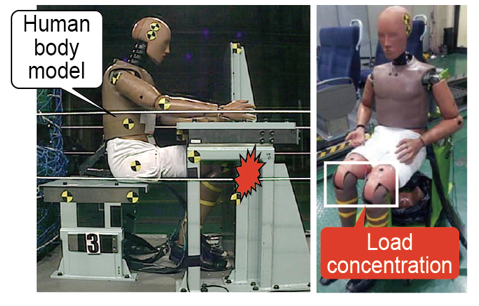
To protect the train driver in collisions between trains and large automobiles at level crossings, measures such as improving the energy absorption capability of the train carbody and securing survival space have been implemented. In recent years, research has also been conducted on mitigating impacts between the driver and the cab interior. Human body model impact tests (Fig. 1) are used to assess driver injury risk. However, there are challenges in that only a limited number of organizations are capable of conducting such tests and the testing costs are high.
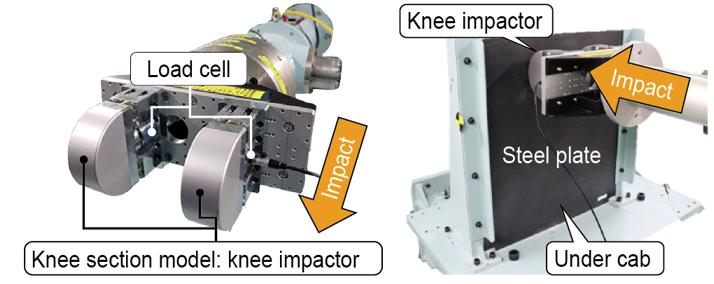
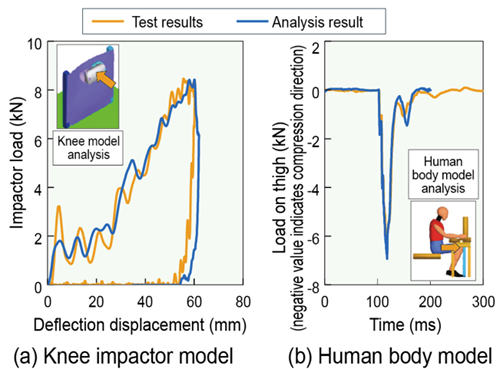
To address this issue, RTRI focused on the thigh, where the risk of injury is high, and developed a new impact test method (knee impact test) using a partial knee model that enables simple and highly accurate evaluation of driver injury risk (Fig. 2). In addition, a numerical analysis model capable of highly accurately reproducing both knee impact tests and human body model tests was developed, establishing an environment that enables investigation of impact phenomena through digital testing (Fig. 3).
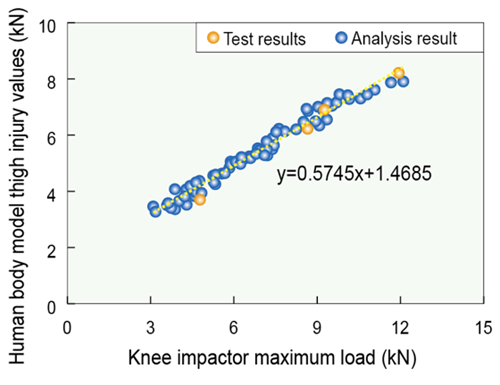
The validity of the proposed knee impact test was examined through comparison with human body model tests in four cases, including different methods of fixing the steel plate beneath the cab and different seating positions of the human body model. In addition, 69 cases were reproduced through numerical analysis. Although differences were observed due to factors such as changes in the effective mass of the human body model during impact, it was found that results equivalent to those of the human body model tests can be obtained by correcting the knee impact test results (Fig. 4). The risk of injury severity of the cab can be evaluated by comparing the thigh injury values with various reference values.
The proposed knee impact test and digital testing can be utilized for determining cab specifications and examining damage mitigation measures.
Other Contents
- 27. Method for Evaluating Erosion on Embankment Slopes Induced by Rainfall
- 28. Snow Accretion Simulation Based on a Constitutive Law for Snow Throwing by Wheels
- 29. Simulation Method for Impact Response of Track Members under Wheel Flat Conditions
- 30. Mechanism of Lift Force Variation in Shinkansen Pantograph Heads
- 31. Knee Impact Test to Assess Driver Injury Risk in Train Accidents
- 27. Method for Evaluating Erosion on Embankment Slopes Induced by Rainfall
- 28. Snow Accretion Simulation Based on a Constitutive Law for Snow Throwing by Wheels
- 29. Simulation Method for Impact Response of Track Members under Wheel Flat Conditions
- 30. Mechanism of Lift Force Variation in Shinkansen Pantograph Heads
- 31. Knee Impact Test to Assess Driver Injury Risk in Train Accidents