
28. Snow Accretion Simulation Based on a Constitutive Law for Snow Throwing by Wheels
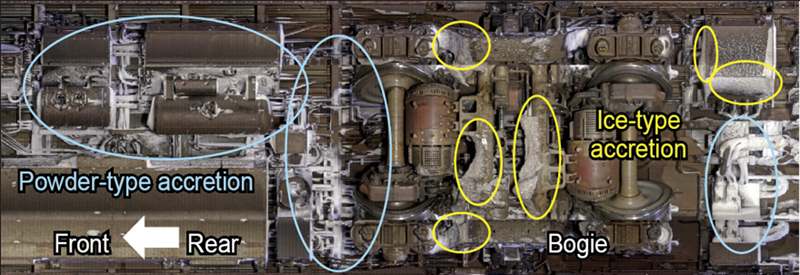
When railway vehicles operate in snowy regions, snow accretion occurs as shown in Fig. 1, with powder-type accretion forming in front of the bogie and ice-type accretion forming from the center to the rear of the bogie. In particular, ice-type snow accretion may damage track equipment such as turnouts and signaling facilities if it falls. The existing snow accretion simulator could handle powder-type accretion caused by snow blowing, but could not reproduce ice-type accretion. It is considered that ice-type snow accretion is caused by snow being thrown from the wheels.
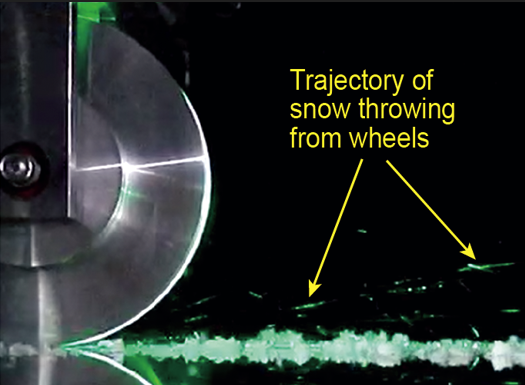
Therefore, a snow throwing test was conducted to clarify the snow throwing mechanism. It was found that part of the snow thrown from the wheels partially melts, becomes water content, and then transforms into ice-type snow accretion. In addition, the locations of snow throwing from wheels and its trajectories were clarified (Fig. 2).
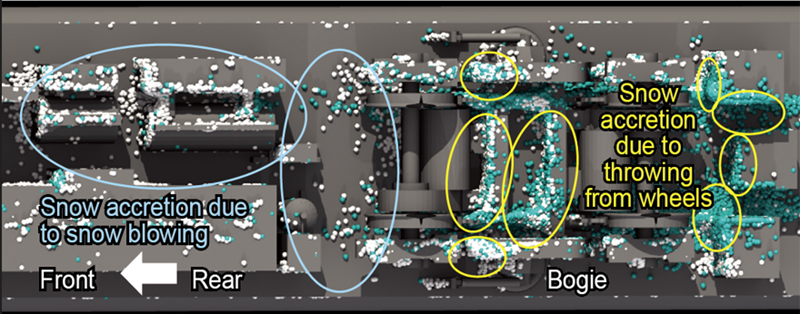
A constitutive law for snow throwing capable of representing these phenomena was developed, implemented in an existing snow accretion simulator, and verified using images of snow accretion under the floor of a conventional line vehicle (Fig. 1). As a result, the simulation reproduced powder-type accretion caused by snow blowing in front of the bogie and ice-type accretion caused by snow throwing from the center to the rear of the bogie. The results were consistent with the observed snow accretion distribution (Fig. 3).
These findings enable the quantitative evaluation of not only powder-type accretion but also ice-type accretion, which is more likely to cause damage to railway equipment. This also enables support for the design of snow accretion prevention structures and the prediction of countermeasure effectiveness for railway operators, and is expected to contribute to improved safety and more efficient maintenance work.
Other Contents
- 27. Method for Evaluating Erosion on Embankment Slopes Induced by Rainfall
- 28. Snow Accretion Simulation Based on a Constitutive Law for Snow Throwing by Wheels
- 29. Simulation Method for Impact Response of Track Members under Wheel Flat Conditions
- 30. Mechanism of Lift Force Variation in Shinkansen Pantograph Heads
- 31. Knee Impact Test to Assess Driver Injury Risk in Train Accidents
- 27. Method for Evaluating Erosion on Embankment Slopes Induced by Rainfall
- 28. Snow Accretion Simulation Based on a Constitutive Law for Snow Throwing by Wheels
- 29. Simulation Method for Impact Response of Track Members under Wheel Flat Conditions
- 30. Mechanism of Lift Force Variation in Shinkansen Pantograph Heads
- 31. Knee Impact Test to Assess Driver Injury Risk in Train Accidents