
29. Simulation Method for Impact Response of Track Members under Wheel Flat Conditions
When a vehicle with wheel flats runs, a large impact force is generated at the wheel-rail interface, which may lead to damage to track members such as fracture of prestressed concrete (PC) sleepers. However, it had not been clarified how track members respond to variations in car classification, wheel flat size and shape, and track conditions.
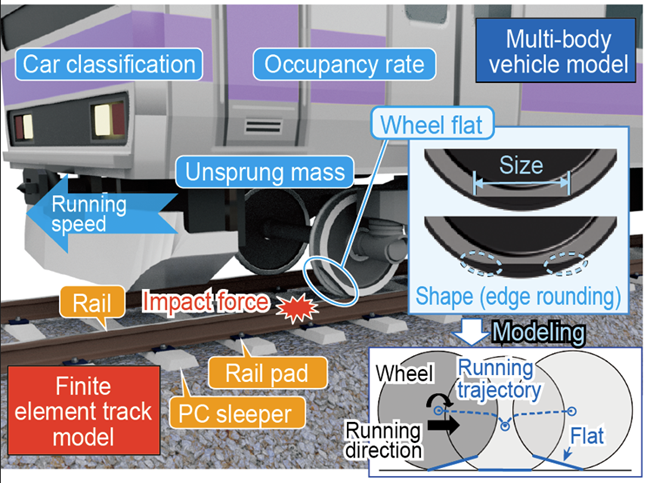
Therefore, a numerical simulation method was developed to calculate the impact response of track members induced by the passage of vehicles with wheel flats (Fig. 1). This method uses a multi-body vehicle model with wheel irregularities simulating wheel flats, running on a track modeled using the finite element method, and allows vehicle and track conditions to be specified for any line section. This method also achieves high-speed computation by representing wheel flats as the wheel running trajectory, while also allowing various nonlinear characteristics, including the compressive behavior of rail pads, to be taken into account.
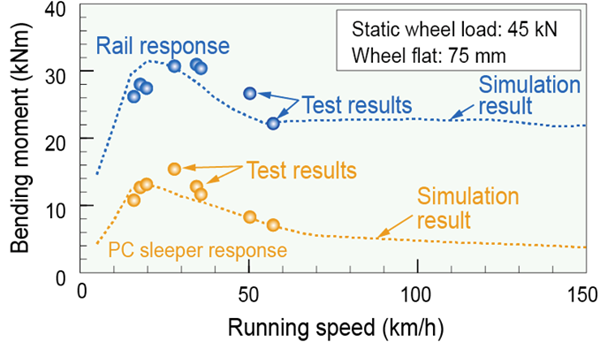
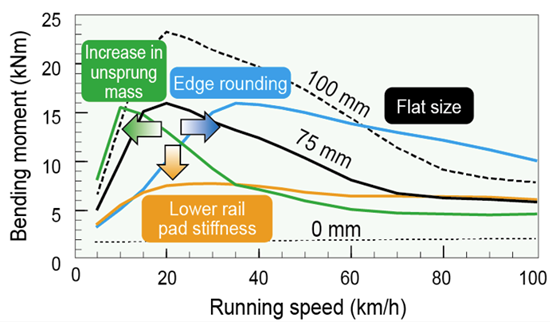
To validate this method, comparison was made with running test results of a vehicle equipped with artificially introduced wheel flats, and it was confirmed that the bending responses of rails and PC sleepers can be accurately calculated (Fig. 2). In addition, a parametric study with varying vehicle and track conditions clarified the effects of wheel flat size and shape (edge rounding), unsprung mass of the vehicle, and rail pad type on the response of track members (Fig. 3).
This method can be utilized for the design of PC sleepers according to line conditions, for setting replacement timing criteria for PC sleepers that have exceeded their service life, for quantifying the reduction effects on track member responses when introducing high-performance materials such as low-stiffness rail pads, and as a tool for investigating the causes of PC sleeper fracture.
Other Contents
- 27. Method for Evaluating Erosion on Embankment Slopes Induced by Rainfall
- 28. Snow Accretion Simulation Based on a Constitutive Law for Snow Throwing by Wheels
- 29. Simulation Method for Impact Response of Track Members under Wheel Flat Conditions
- 30. Mechanism of Lift Force Variation in Shinkansen Pantograph Heads
- 31. Knee Impact Test to Assess Driver Injury Risk in Train Accidents
- 27. Method for Evaluating Erosion on Embankment Slopes Induced by Rainfall
- 28. Snow Accretion Simulation Based on a Constitutive Law for Snow Throwing by Wheels
- 29. Simulation Method for Impact Response of Track Members under Wheel Flat Conditions
- 30. Mechanism of Lift Force Variation in Shinkansen Pantograph Heads
- 31. Knee Impact Test to Assess Driver Injury Risk in Train Accidents