
30. Mechanism of Lift Force Variation in Shinkansen Pantograph Heads
For Shinkansen pantographs to achieve stable current collection, appropriate lift force must act on the pantograph head (Fig. 1), and a cross-sectional shape of the pantograph head that does not cause large variations in lift force even under wear of contact strip must be selected. On the other hand, many aspects of the mechanism behind lift force variation caused by changes in the pantograph head cross-sectional shape remain unclear. As a result, shape selection is currently carried out primarily through trial-and-error wind tunnel testing, making reduction of development time and cost key challenges.
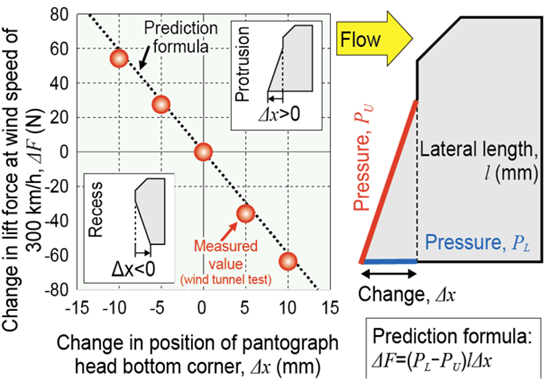
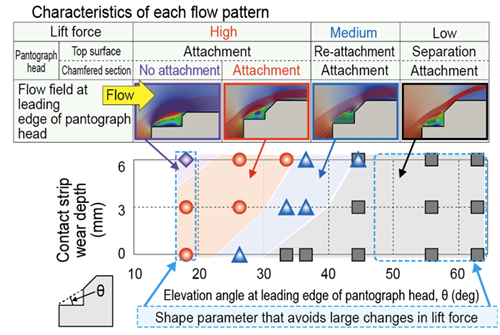
In this study, the mechanism of lift force variation was clarified for two pantograph head shapes widely used in Shinkansen pantographs by combining wind tunnel tests and CFD (Computational Fluid Dynamics). Specifically, for (i) a lift force adjustment method using a front-face inclination on a rectangular pantograph head, the mechanism of lift force variation was clarified, and a prediction formula was proposed to estimate the amount of lift force variation from the pressure and surface area around the inclined section. Validation through wind tunnel tests confirmed that the values estimated by the prediction formula agreed well with the measured values (Fig. 2). For (ii) stepped pantograph heads, the relationship between pantograph head cross-sectional shape and lift characteristics was investigated. The results revealed that large lift force variations occur due to significant changes in the flow pattern around the leading edge of the pantograph head as contact strip wearing depth increases. In addition, it was found that the relationship between flow pattern and lift force characteristics can be classified according to the elevation angle at the leading edge of the pantograph head, and the range of elevation angles that avoids large lift force variations during contact strip wear was clarified (Fig. 3). These findings can reduce the effort required for the design and testing of pantograph head cross-sectional shapes, thereby improving development efficiency and reducing the risk of lift-force-induced failures.

Other Contents
- 27. Method for Evaluating Erosion on Embankment Slopes Induced by Rainfall
- 28. Snow Accretion Simulation Based on a Constitutive Law for Snow Throwing by Wheels
- 29. Simulation Method for Impact Response of Track Members under Wheel Flat Conditions
- 30. Mechanism of Lift Force Variation in Shinkansen Pantograph Heads
- 31. Knee Impact Test to Assess Driver Injury Risk in Train Accidents
- 27. Method for Evaluating Erosion on Embankment Slopes Induced by Rainfall
- 28. Snow Accretion Simulation Based on a Constitutive Law for Snow Throwing by Wheels
- 29. Simulation Method for Impact Response of Track Members under Wheel Flat Conditions
- 30. Mechanism of Lift Force Variation in Shinkansen Pantograph Heads
- 31. Knee Impact Test to Assess Driver Injury Risk in Train Accidents