
7. Fretting Wear Mitigation Method for Axle Journal Bearings
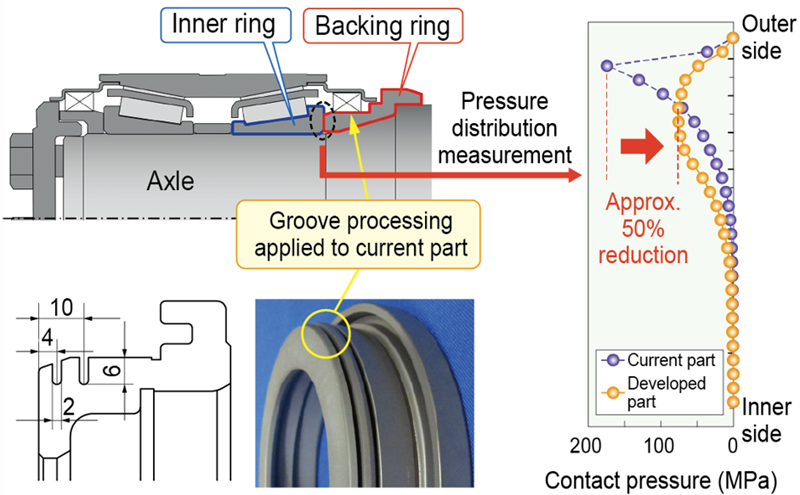
Fretting wear particles generated at the interface between the inner ring and the backing ring of the axle journal bearing (the contact area between the blue and red in the upper-left of Fig. 1) accelerate lubricant degradation and have become a bottleneck in extending inspection intervals for railway vehicles. Preventing fretting wear has been challenging because it occurs predominantly in regions where deformation of the backing ring during bearing assembly results in a non-uniform contact pressure distribution at the interface with the inner ring. Conventional countermeasures, such as inserting an O-ring or a backing plate between the inner ring and the backing ring, cannot prevent the generation of wear particles itself. In addition, they require design modifications to existing bearings and increase the number of components, thereby introducing a risk of installation errors. To address these issues, a new mitigation method that requires neither major design modifications nor an increase in the number of components was developed.
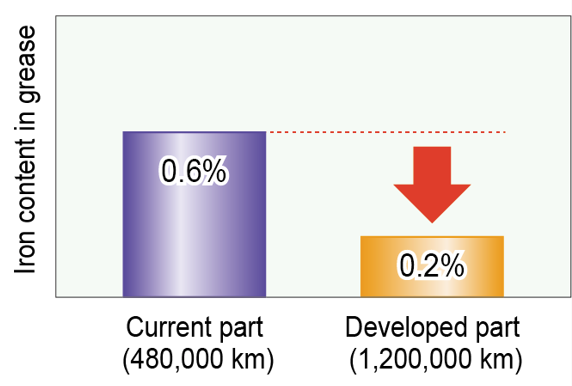
To suppress fretting wear, finite element analysis was used to determine a backing ring geometry that would produce a more uniform contact pressure distribution. As a result, we devised a method for reducing the influence of backing ring deformation on the contact pressure distribution by machining an additional circumferential groove into the existing backing ring (Fig. 1, lower panel). Experimental measurements of contact pressure using the developed backing ring demonstrated that the pressure distribution was significantly more uniform, resulting in an approximately 50% reduction in maximum contact pressure compared with the current design (Fig. 1, right). In addition, no dimensional changes caused by the groove machining nor any cracks at the groove root were observed during an active duty car running test covering approximately 550,000 km, indicating that the proposed design is suitable for practical use. Furthermore, durability evaluation using a bench rotation test equivalent to approximately 1.2 million km of operation confirmed that the iron content in the grease was reduced by approximately 65% compared with that of the current design after the equivalent of 480,000 km of operation (Fig. 2).
The proposed method is expected to enable further extension of inspection intervals for railway vehicles and contribute to reducing maintenance labor requirements.
Other Contents
- 7. Fretting Wear Mitigation Method for Axle Journal Bearings
- 8. Construction, Inspection, and Reinforcement Methods for Preventing Fracture of Aluminothermic Weldings
- 9. Rail Head Transverse Crack Detection using Guide Waves
- 10. Automation of Spalling Condition Assessment Using Hammering Sound Judgment AI and Hammer Auto-tracking
- 11. Embankment Quality Control Methods Using Construction Phase Settlement Data
- 12. Damage Estimation and Visualization Tool for Signaling Facilities Affected by Snow Dropping from High-Speed Vehicles
- 13. Marker-Assisted Platform Position Measurement Using Forward-View Train Images
- 14. Anomaly Screening Method for Overhead Contact Line Equipment Requiring High-Frequency Inspection
- 15. Method for Identifying Causes of Failures in Electric Point Machines
- 16. Performance Evaluation Method for Inspection Systems Using Cameras and Sensors Based on CG Simulation
- 17. Method for Constructing 3D Railway Track Spatial Data Using In-service Trains
- 18. Safety Confirmation-Based Train Control System
- 19. Comprehension Visualization System for Trainees in Remote Lectures for Driver Training
- 7. Fretting Wear Mitigation Method for Axle Journal Bearings
- 8. Construction, Inspection, and Reinforcement Methods for Preventing Fracture of Aluminothermic Weldings
- 9. Rail Head Transverse Crack Detection using Guide Waves
- 10. Automation of Spalling Condition Assessment Using Hammering Sound Judgment AI and Hammer Auto-tracking
- 11. Embankment Quality Control Methods Using Construction Phase Settlement Data
- 12. Damage Estimation and Visualization Tool for Signaling Facilities Affected by Snow Dropping from High-Speed Vehicles
- 13. Marker-Assisted Platform Position Measurement Using Forward-View Train Images
- 14. Anomaly Screening Method for Overhead Contact Line Equipment Requiring High-Frequency Inspection
- 15. Method for Identifying Causes of Failures in Electric Point Machines
- 16. Performance Evaluation Method for Inspection Systems Using Cameras and Sensors Based on CG Simulation
- 17. Method for Constructing 3D Railway Track Spatial Data Using In-service Trains
- 18. Safety Confirmation-Based Train Control System
- 19. Comprehension Visualization System for Trainees in Remote Lectures for Driver Training