
8. Construction, Inspection, and Reinforcement Methods for Preventing Fracture of Aluminothermic Weldings
Aluminothermic welding, one of the rail welding methods, has been employed on conventional lines for approximately 50 years and provides sufficient strength for practical use. However, its application to high-speed Shinkansen sections, where the impact of transport disorders is particularly significant, has not been adopted because its bending fatigue strength is relatively lower than that of other rail welding methods, and because there is a risk of premature fracture if a solidification crack (a welding defect that can occur when the rail moves slightly outward during solidification of molten steel) is overlooked during ultrasonic testing.
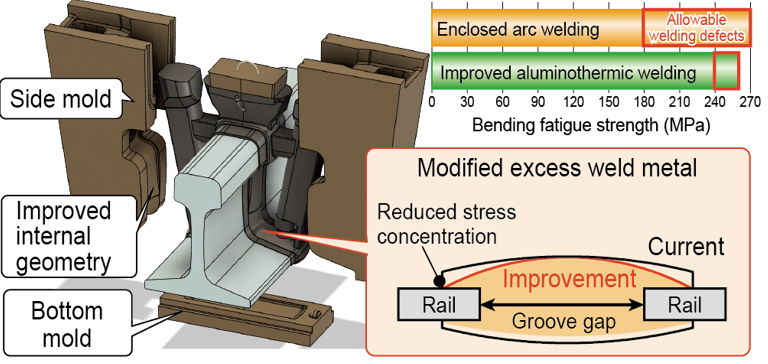
To address these challenges, an improved aluminothermic welding method suitable for application to high-speed Shinkansen sections was proposed. Specifically, to reduce stress concentration at the excess weld metal end, the internal geometry of the three-piece mold was modified. This improvement increased the bending fatigue strength by more than 20%, bringing it to a level nearly equivalent to that of enclosed arc welding, the primary field welding method currently used on Shinkansen lines (Fig. 1).
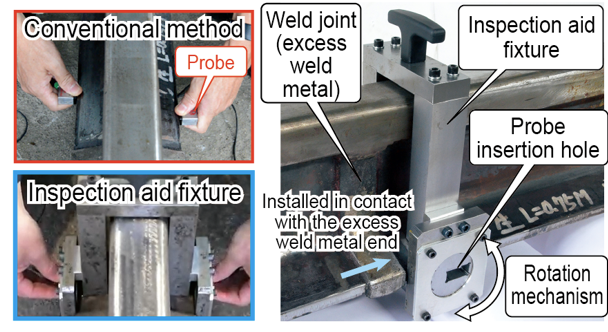
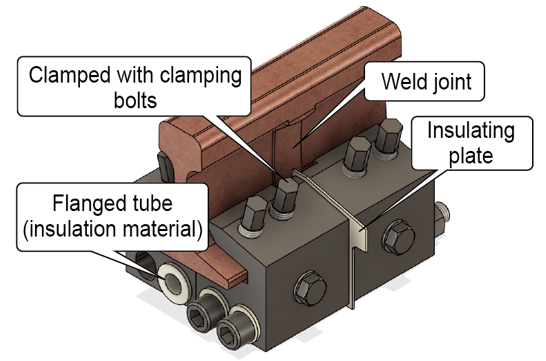
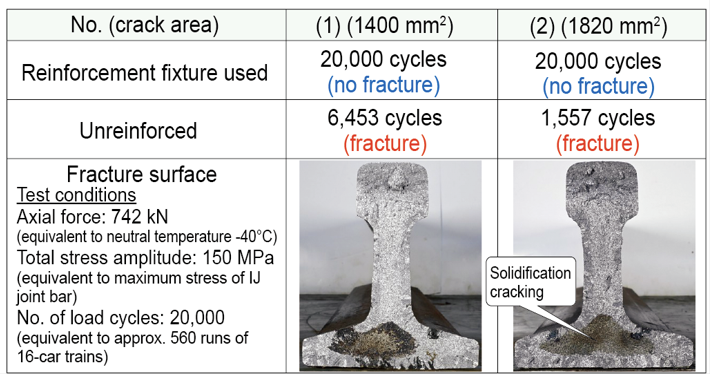
In addition, an inspection aid fixture was developed that enables solidification cracks to be readily detected by post-weld ultrasonic testing, should such cracks occur in the weld (Fig. 2). This fixture reduces the level of operator skill required for crack detection by supporting probe pivot scanning and proper probe positioning. Furthermore, we developed a reinforcement fixture that allows trains to continue operating at normal speeds until the next nighttime maintenance window, when rail replacement can be carried out, even if a solidification crack has occurred in an aluminothermic weld (Fig. 3, Table 1).
The proposed method prevents fracture of aluminothermic welds and significantly improves weld reliability, thereby helping to maintain stable railway operations. In addition, it can reduce both labor requirements and costs by approximately 30% compared with the current welding method, which requires a high level of operator skill.
Other Contents
- 7. Fretting Wear Mitigation Method for Axle Journal Bearings
- 8. Construction, Inspection, and Reinforcement Methods for Preventing Fracture of Aluminothermic Weldings
- 9. Rail Head Transverse Crack Detection using Guide Waves
- 10. Automation of Spalling Condition Assessment Using Hammering Sound Judgment AI and Hammer Auto-tracking
- 11. Embankment Quality Control Methods Using Construction Phase Settlement Data
- 12. Damage Estimation and Visualization Tool for Signaling Facilities Affected by Snow Dropping from High-Speed Vehicles
- 13. Marker-Assisted Platform Position Measurement Using Forward-View Train Images
- 14. Anomaly Screening Method for Overhead Contact Line Equipment Requiring High-Frequency Inspection
- 15. Method for Identifying Causes of Failures in Electric Point Machines
- 16. Performance Evaluation Method for Inspection Systems Using Cameras and Sensors Based on CG Simulation
- 17. Method for Constructing 3D Railway Track Spatial Data Using In-service Trains
- 18. Safety Confirmation-Based Train Control System
- 19. Comprehension Visualization System for Trainees in Remote Lectures for Driver Training
- 7. Fretting Wear Mitigation Method for Axle Journal Bearings
- 8. Construction, Inspection, and Reinforcement Methods for Preventing Fracture of Aluminothermic Weldings
- 9. Rail Head Transverse Crack Detection using Guide Waves
- 10. Automation of Spalling Condition Assessment Using Hammering Sound Judgment AI and Hammer Auto-tracking
- 11. Embankment Quality Control Methods Using Construction Phase Settlement Data
- 12. Damage Estimation and Visualization Tool for Signaling Facilities Affected by Snow Dropping from High-Speed Vehicles
- 13. Marker-Assisted Platform Position Measurement Using Forward-View Train Images
- 14. Anomaly Screening Method for Overhead Contact Line Equipment Requiring High-Frequency Inspection
- 15. Method for Identifying Causes of Failures in Electric Point Machines
- 16. Performance Evaluation Method for Inspection Systems Using Cameras and Sensors Based on CG Simulation
- 17. Method for Constructing 3D Railway Track Spatial Data Using In-service Trains
- 18. Safety Confirmation-Based Train Control System
- 19. Comprehension Visualization System for Trainees in Remote Lectures for Driver Training