
13. Marker-Assisted Platform Position Measurement Using Forward-View Train Images
Since station platforms located close to passing trains require strict positional control, voluntary inspections are conducted every one to two years in addition to the legal inspections performed every four years. Inspections require significant manpower, as engineers must go to the site and manually measure the height and lateral gap of platforms relative to the rail (hereinafter referred to as platform position) using dedicated instruments. On the other hand, if platform position could be measured from trains using forward-view train video (hereinafter referred to as forward-view train images), which has recently been introduced by many railway operators for equipment diagnosis, it would be possible to reduce the manpower required for inspections.
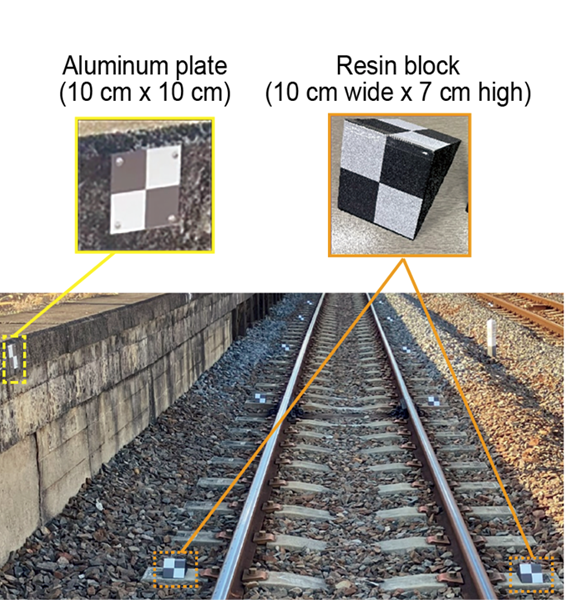
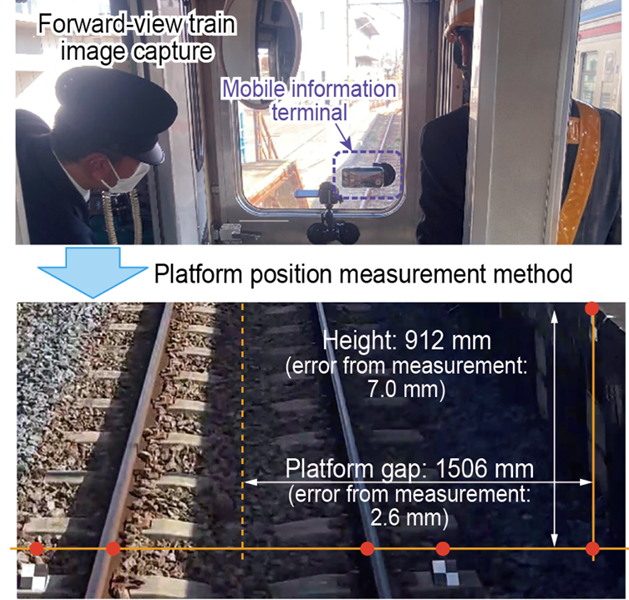
However, when using forward-view train images captured with a monocular camera such as a mobile device, it has been difficult to ensure sufficient measurement accuracy, particularly in the depth direction, which has been a key issue in measuring station platform position. To address this, we developed a method that places three dedicated markers at a single measurement cross-section of a station platform (requiring approx. 20 minutes for installation) and enables high-accuracy measurement of depth positions and dimensions using the markers captured in forward-view train images as references (Fig. 1). With this method, platform position can be measured at low cost even using images captured with a standard video camera or a mobile device (Fig. 2).
As a result of validation at approximately 35 station platforms on an actual railway line, it was confirmed that when using forward-view train images of limited express trains passing at approximately 80 km/h under clear weather conditions, platform position can be measured with mean errors of 15 mm in height and 10 mm in platform gap.
By utilizing forward-view train images acquired during routine train patrols, this method enables high-frequency monitoring of platform position, thereby eliminating the need for on-site platform position measurements and enabling focused monitoring of locations requiring attention due to small platform gaps.
Other Contents
- 7. Fretting Wear Mitigation Method for Axle Journal Bearings
- 8. Construction, Inspection, and Reinforcement Methods for Preventing Fracture of Aluminothermic Weldings
- 9. Rail Head Transverse Crack Detection using Guide Waves
- 10. Automation of Spalling Condition Assessment Using Hammering Sound Judgment AI and Hammer Auto-tracking
- 11. Embankment Quality Control Methods Using Construction Phase Settlement Data
- 12. Damage Estimation and Visualization Tool for Signaling Facilities Affected by Snow Dropping from High-Speed Vehicles
- 13. Marker-Assisted Platform Position Measurement Using Forward-View Train Images
- 14. Anomaly Screening Method for Overhead Contact Line Equipment Requiring High-Frequency Inspection
- 15. Method for Identifying Causes of Failures in Electric Point Machines
- 16. Performance Evaluation Method for Inspection Systems Using Cameras and Sensors Based on CG Simulation
- 17. Method for Constructing 3D Railway Track Spatial Data Using In-service Trains
- 18. Safety Confirmation-Based Train Control System
- 19. Comprehension Visualization System for Trainees in Remote Lectures for Driver Training
- 7. Fretting Wear Mitigation Method for Axle Journal Bearings
- 8. Construction, Inspection, and Reinforcement Methods for Preventing Fracture of Aluminothermic Weldings
- 9. Rail Head Transverse Crack Detection using Guide Waves
- 10. Automation of Spalling Condition Assessment Using Hammering Sound Judgment AI and Hammer Auto-tracking
- 11. Embankment Quality Control Methods Using Construction Phase Settlement Data
- 12. Damage Estimation and Visualization Tool for Signaling Facilities Affected by Snow Dropping from High-Speed Vehicles
- 13. Marker-Assisted Platform Position Measurement Using Forward-View Train Images
- 14. Anomaly Screening Method for Overhead Contact Line Equipment Requiring High-Frequency Inspection
- 15. Method for Identifying Causes of Failures in Electric Point Machines
- 16. Performance Evaluation Method for Inspection Systems Using Cameras and Sensors Based on CG Simulation
- 17. Method for Constructing 3D Railway Track Spatial Data Using In-service Trains
- 18. Safety Confirmation-Based Train Control System
- 19. Comprehension Visualization System for Trainees in Remote Lectures for Driver Training