
17. Method for Constructing 3D Railway Track Spatial Data Using In-service Trains
Maintenance of railway trackside facilities requires personnel to conduct on-site inspections on foot, which involves considerable labor. In particular, visibility inspections of obstruction warning signals that warn of abnormalities such as level crossing incidents are a typical example of maintenance work with high costs, as they must be checked continuously from the driver's line of sight over distances of up to 800 m. MMS (Mobile Mapping Systems) and similar technologies have traditionally been used to improve the efficiency of such maintenance work. However, their deployment requires expensive dedicated vehicles and timetable adjustments, posing challenges in terms of both implementation cost and operational burden.
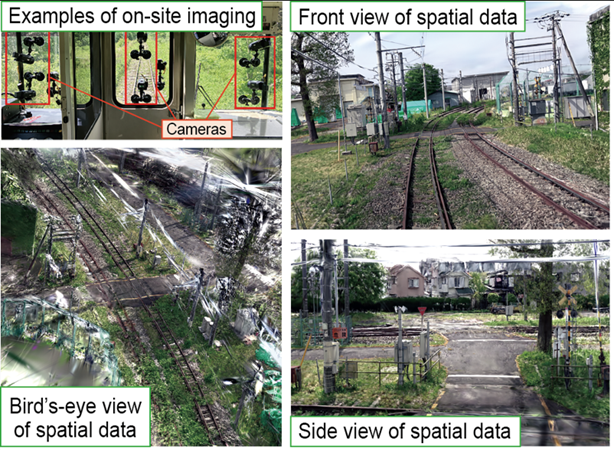
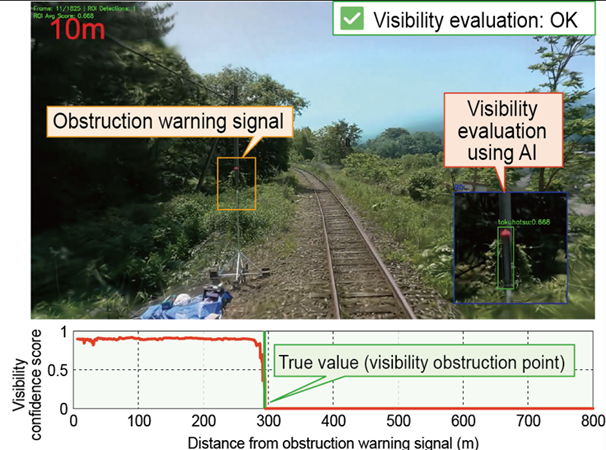
To address this issue, we developed a method for constructing 3D spatial data of railway tracksides from images captured by commercially available video cameras installed in the cab of in-service trains (Fig. 1). In general, constructing 3D spatial data requires a large number of images capturing the target from multiple viewpoints. However, applying such methods to videos acquired from in-service trains is challenging because the train moves in a single direction, resulting in limited viewpoint variation. In this method, viewpoint variation is ensured through optimized camera placement, and high accuracy 3D spatial data construction is achieved even with limited viewpoint variation using deep learning-based image matching. As an application of the constructed 3D spatial data, we developed an AI-based automatic visibility inspection system for obstruction warning signals (Fig. 2).
On an actual railway track, 3D spatial data were constructed for an 800 m section approaching an obstruction warning signal using four cameras mounted in the driver's cab, and system validation tests were conducted. Validation tests simulating obstructed visibility using shields confirmed that locations with poor visibility could be identified in the 3D space with an accuracy of approximately 3 m, and the results were consistent with on-site observations. These results confirmed that visibility inspections of obstruction warning signals can be performed without requiring personnel to visit the actual site.
This method enables low-cost and straightforward construction of 3D spatial data along railway tracksides and allows continuous updating and accumulation of data through frequent operation. In addition to visibility inspections, the method is expected to be applicable to various maintenance activities that require knowledge of the position and geometry of facilities, such as construction planning and the assessment of pole inclination.
Other Contents
- 7. Fretting Wear Mitigation Method for Axle Journal Bearings
- 8. Construction, Inspection, and Reinforcement Methods for Preventing Fracture of Aluminothermic Weldings
- 9. Rail Head Transverse Crack Detection using Guide Waves
- 10. Automation of Spalling Condition Assessment Using Hammering Sound Judgment AI and Hammer Auto-tracking
- 11. Embankment Quality Control Methods Using Construction Phase Settlement Data
- 12. Damage Estimation and Visualization Tool for Signaling Facilities Affected by Snow Dropping from High-Speed Vehicles
- 13. Marker-Assisted Platform Position Measurement Using Forward-View Train Images
- 14. Anomaly Screening Method for Overhead Contact Line Equipment Requiring High-Frequency Inspection
- 15. Method for Identifying Causes of Failures in Electric Point Machines
- 16. Performance Evaluation Method for Inspection Systems Using Cameras and Sensors Based on CG Simulation
- 17. Method for Constructing 3D Railway Track Spatial Data Using In-service Trains
- 18. Safety Confirmation-Based Train Control System
- 19. Comprehension Visualization System for Trainees in Remote Lectures for Driver Training
- 7. Fretting Wear Mitigation Method for Axle Journal Bearings
- 8. Construction, Inspection, and Reinforcement Methods for Preventing Fracture of Aluminothermic Weldings
- 9. Rail Head Transverse Crack Detection using Guide Waves
- 10. Automation of Spalling Condition Assessment Using Hammering Sound Judgment AI and Hammer Auto-tracking
- 11. Embankment Quality Control Methods Using Construction Phase Settlement Data
- 12. Damage Estimation and Visualization Tool for Signaling Facilities Affected by Snow Dropping from High-Speed Vehicles
- 13. Marker-Assisted Platform Position Measurement Using Forward-View Train Images
- 14. Anomaly Screening Method for Overhead Contact Line Equipment Requiring High-Frequency Inspection
- 15. Method for Identifying Causes of Failures in Electric Point Machines
- 16. Performance Evaluation Method for Inspection Systems Using Cameras and Sensors Based on CG Simulation
- 17. Method for Constructing 3D Railway Track Spatial Data Using In-service Trains
- 18. Safety Confirmation-Based Train Control System
- 19. Comprehension Visualization System for Trainees in Remote Lectures for Driver Training