
9. Rail Head Transverse Crack Detection using Guide Waves
Among defects in the rail head, transverse cracks are particularly critical because their growth may lead to rail breakage, making their management essential. Transverse cracks form beneath horizontal cracks located just below the rail head surface, making them difficult to detect in primary inspections by inspection vehicles, which injects obliquely downward ultrasonic waves from the rail head top. Locations where horizontal cracks are detected undergo a separate secondary inspection, in which engineers perform ultrasonic testing to determine whether transverse cracks are present. For this reason, there has been a demand to reduce the labor and cost of such inspections.
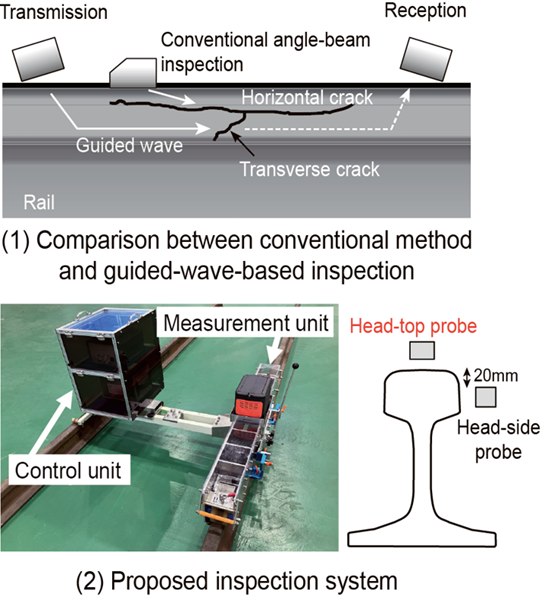
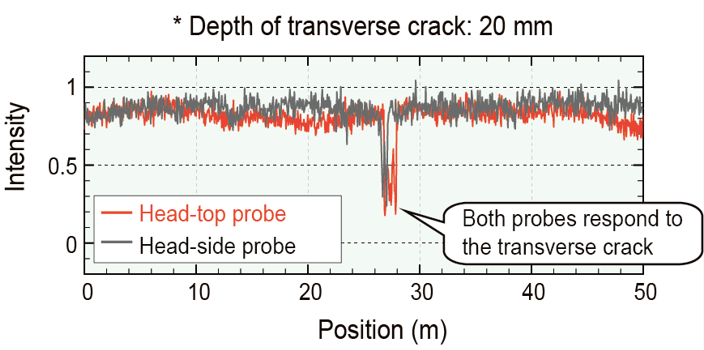
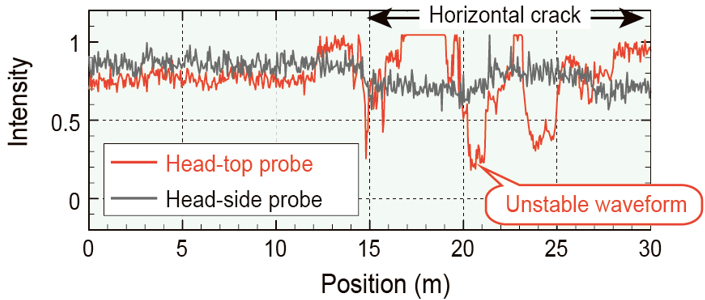
To address this issue, we developed a system that transmits and receives guide waves (non-contact ultrasonic waves propagating along the rail in the longitudinal direction with low attenuation) and detects transverse cracks based on changes in the received signal level (Fig. 1). Using a prototype that incorporated optimal conditions for guided-wave incident angle, frequency, and other parameters obtained from ultrasonic propagation simulations, we conducted verification tests on a commercial line. When horizontal cracks are short, we confirmed that the system can detect transverse cracks 15 mm or more in depth based on changes in the received level of guided waves transmitted and received at the rail head top (Fig. 2). When horizontal cracks exceed 1 m in length, we confirmed that transverse cracks can be detected from the rail head side without being affected by the horizontal crack (Fig. 3).
The developed system can replace secondary inspections currently performed to identify transverse cracks. Furthermore, the proposed method enables faster and continuous detection of transverse cracks in the rail head compared to conventional secondary inspections, reducing inspection time by more than 50%.
Other Contents
- 7. Fretting Wear Mitigation Method for Axle Journal Bearings
- 8. Construction, Inspection, and Reinforcement Methods for Preventing Fracture of Aluminothermic Weldings
- 9. Rail Head Transverse Crack Detection using Guide Waves
- 10. Automation of Spalling Condition Assessment Using Hammering Sound Judgment AI and Hammer Auto-tracking
- 11. Embankment Quality Control Methods Using Construction Phase Settlement Data
- 12. Damage Estimation and Visualization Tool for Signaling Facilities Affected by Snow Dropping from High-Speed Vehicles
- 13. Marker-Assisted Platform Position Measurement Using Forward-View Train Images
- 14. Anomaly Screening Method for Overhead Contact Line Equipment Requiring High-Frequency Inspection
- 15. Method for Identifying Causes of Failures in Electric Point Machines
- 16. Performance Evaluation Method for Inspection Systems Using Cameras and Sensors Based on CG Simulation
- 17. Method for Constructing 3D Railway Track Spatial Data Using In-service Trains
- 18. Safety Confirmation-Based Train Control System
- 19. Comprehension Visualization System for Trainees in Remote Lectures for Driver Training
- 7. Fretting Wear Mitigation Method for Axle Journal Bearings
- 8. Construction, Inspection, and Reinforcement Methods for Preventing Fracture of Aluminothermic Weldings
- 9. Rail Head Transverse Crack Detection using Guide Waves
- 10. Automation of Spalling Condition Assessment Using Hammering Sound Judgment AI and Hammer Auto-tracking
- 11. Embankment Quality Control Methods Using Construction Phase Settlement Data
- 12. Damage Estimation and Visualization Tool for Signaling Facilities Affected by Snow Dropping from High-Speed Vehicles
- 13. Marker-Assisted Platform Position Measurement Using Forward-View Train Images
- 14. Anomaly Screening Method for Overhead Contact Line Equipment Requiring High-Frequency Inspection
- 15. Method for Identifying Causes of Failures in Electric Point Machines
- 16. Performance Evaluation Method for Inspection Systems Using Cameras and Sensors Based on CG Simulation
- 17. Method for Constructing 3D Railway Track Spatial Data Using In-service Trains
- 18. Safety Confirmation-Based Train Control System
- 19. Comprehension Visualization System for Trainees in Remote Lectures for Driver Training