
11. Embankment Quality Control Methods Using Construction Phase Settlement Data
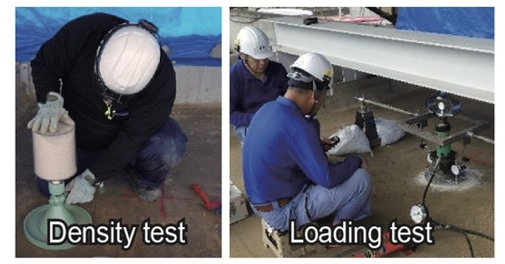
During railway embankment construction, density and loading tests are manually conducted at several locations after compaction by a roller to verify density and stiffness quality (Fig. 1). In recent years, labor shortages at construction sites have become increasingly severe, creating a need for technologies to reduce manpower requirements in quality control operations and reduce the burden on field personnel.
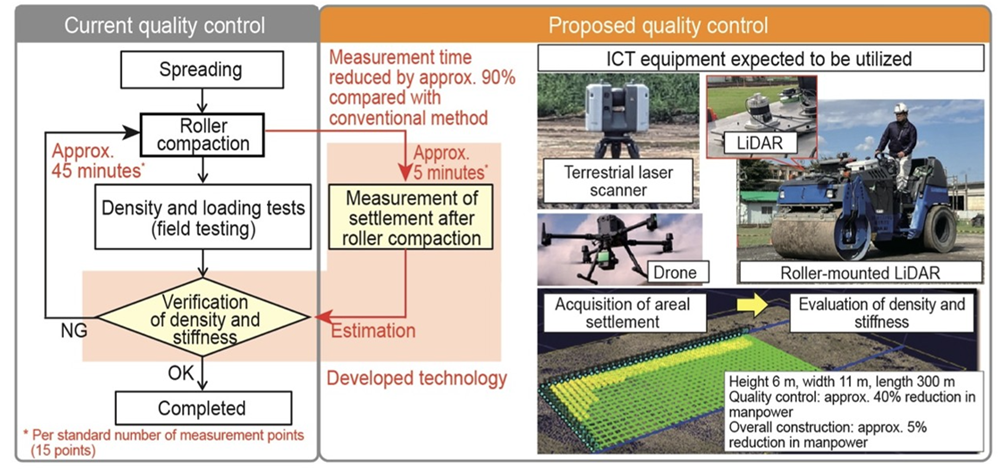
To address this issue, we developed a method for evaluating stiffness by regarding compaction using a roller as a constant-load loading/unloading process, and by combining the coefficient of subgrade reaction during unloading, estimated in advance from plate loading tests, with settlement data measured after compaction. Furthermore, we developed a settlement-based index for evaluating the degree of convergence and the degree of attainment of embankment compaction, and developed a method for evaluating density using this index. Based on these evaluation methods, we then developed a quality control method for embankments (Fig. 2).
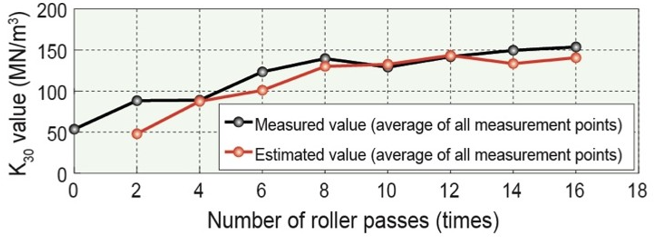
Verification through embankment construction tests confirmed that the proposed method can evaluate stiffness with high accuracy (Fig. 3). Furthermore, embankments with density control using the proposed method exhibited a false warning rate of approximately 18.6% (i.e., density was evaluated conservatively), while the miss rate was kept low at 3.4%, confirming that a quality level equivalent to that of the conventional method can be achieved.
Settlement data can be readily obtained during construction, and the use of ICT equipment can reduce measurement time by approximately 90% and the manpower required for quality control operations by approximately 40% (equivalent to an approximately 5% reduction in total manpower for embankment construction). This method is expected to be incorporated into the Technical Regulatory Standards (Design Standards for Railway Structures and Commentary: Earth Structure).
Other Contents
- 7. Fretting Wear Mitigation Method for Axle Journal Bearings
- 8. Construction, Inspection, and Reinforcement Methods for Preventing Fracture of Aluminothermic Weldings
- 9. Rail Head Transverse Crack Detection using Guide Waves
- 10. Automation of Spalling Condition Assessment Using Hammering Sound Judgment AI and Hammer Auto-tracking
- 11. Embankment Quality Control Methods Using Construction Phase Settlement Data
- 12. Damage Estimation and Visualization Tool for Signaling Facilities Affected by Snow Dropping from High-Speed Vehicles
- 13. Marker-Assisted Platform Position Measurement Using Forward-View Train Images
- 14. Anomaly Screening Method for Overhead Contact Line Equipment Requiring High-Frequency Inspection
- 15. Method for Identifying Causes of Failures in Electric Point Machines
- 16. Performance Evaluation Method for Inspection Systems Using Cameras and Sensors Based on CG Simulation
- 17. Method for Constructing 3D Railway Track Spatial Data Using In-service Trains
- 18. Safety Confirmation-Based Train Control System
- 19. Comprehension Visualization System for Trainees in Remote Lectures for Driver Training
- 7. Fretting Wear Mitigation Method for Axle Journal Bearings
- 8. Construction, Inspection, and Reinforcement Methods for Preventing Fracture of Aluminothermic Weldings
- 9. Rail Head Transverse Crack Detection using Guide Waves
- 10. Automation of Spalling Condition Assessment Using Hammering Sound Judgment AI and Hammer Auto-tracking
- 11. Embankment Quality Control Methods Using Construction Phase Settlement Data
- 12. Damage Estimation and Visualization Tool for Signaling Facilities Affected by Snow Dropping from High-Speed Vehicles
- 13. Marker-Assisted Platform Position Measurement Using Forward-View Train Images
- 14. Anomaly Screening Method for Overhead Contact Line Equipment Requiring High-Frequency Inspection
- 15. Method for Identifying Causes of Failures in Electric Point Machines
- 16. Performance Evaluation Method for Inspection Systems Using Cameras and Sensors Based on CG Simulation
- 17. Method for Constructing 3D Railway Track Spatial Data Using In-service Trains
- 18. Safety Confirmation-Based Train Control System
- 19. Comprehension Visualization System for Trainees in Remote Lectures for Driver Training