
10. Automation of Spalling Condition Assessment Using Hammering Sound Judgment AI and Hammer Auto-tracking
Tunnel inspections require hammering surveys as part of special total inspections at intervals not exceeding 10 years for Shinkansen lines and 20 years for conventional lines. In addition, hammering surveys must also be conducted during regular general inspections every two years to assess spalling conditions. Hammering surveys are labor-intensive, and there is strong demand for labor-saving through digital technologies.
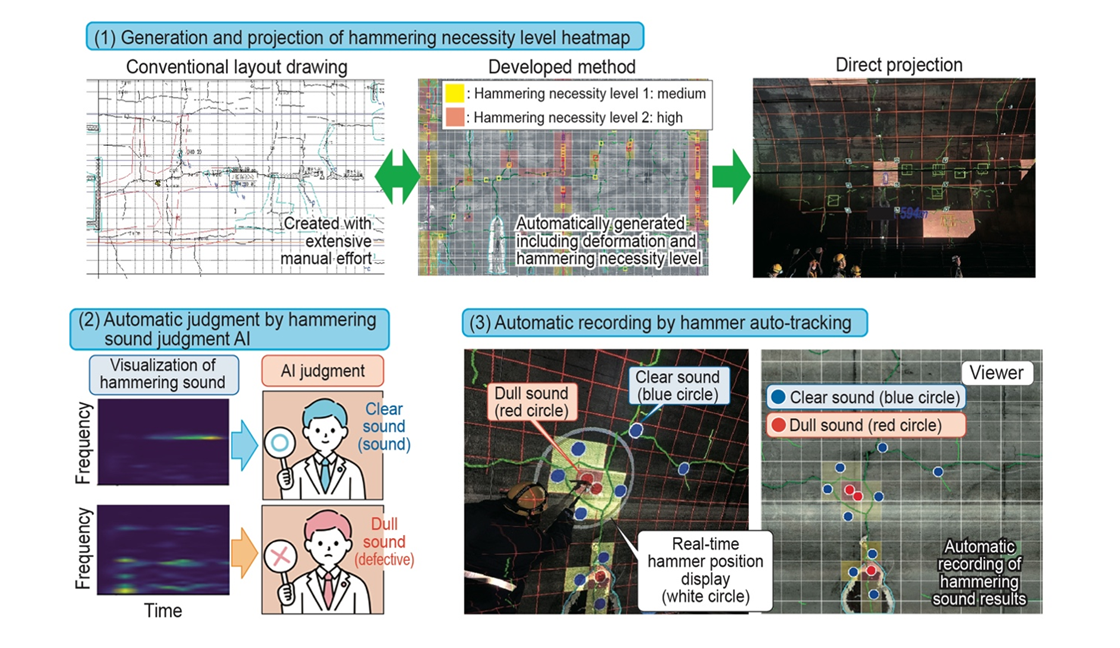
To address this issue, we developed (1) a technology for generating and projecting hammering necessity level heatmaps, (2) an AI-based technology for automatic hammering sound assessment, and (3) a technology for automatically recording assessment results at the corresponding hammered locations (Fig. 1).
Technology (1) extracts deformations such as cracks and water leakage from tunnel wall images using AI, and automatically generates a deformation mapping development diagram that includes hammering necessity levels (a proprietary index based on maintenance standards that indicates the need for hammering surveys).
Technology (2) converts hammering sounds into images with time on the horizontal axis and frequency on the vertical axis, and uses AI to classify the sounds as either clear or dull.
Technology (3) determines the hammering position by attaching a Bluetooth tag to the hammer and a receiver to the projection device, and then measuring the direction from which the received radio signal arrives. The hammered location is then automatically recorded together with the assessment result when hammering is performed.
Spalling conditions can be automatically assessed based on the deformation data and hammering sound judgment results obtained through Technologies (1) to (3).
The developed system can be applied to images taken by individual railway operators and can be deployed on standard freight cars being used for inspection. This enables near-complete automation of development diagram creation, selection of hammering locations in the field, and hammering sound judgment, recording, and condition assessment.
Other Contents
- 7. Fretting Wear Mitigation Method for Axle Journal Bearings
- 8. Construction, Inspection, and Reinforcement Methods for Preventing Fracture of Aluminothermic Weldings
- 9. Rail Head Transverse Crack Detection using Guide Waves
- 10. Automation of Spalling Condition Assessment Using Hammering Sound Judgment AI and Hammer Auto-tracking
- 11. Embankment Quality Control Methods Using Construction Phase Settlement Data
- 12. Damage Estimation and Visualization Tool for Signaling Facilities Affected by Snow Dropping from High-Speed Vehicles
- 13. Marker-Assisted Platform Position Measurement Using Forward-View Train Images
- 14. Anomaly Screening Method for Overhead Contact Line Equipment Requiring High-Frequency Inspection
- 15. Method for Identifying Causes of Failures in Electric Point Machines
- 16. Performance Evaluation Method for Inspection Systems Using Cameras and Sensors Based on CG Simulation
- 17. Method for Constructing 3D Railway Track Spatial Data Using In-service Trains
- 18. Safety Confirmation-Based Train Control System
- 19. Comprehension Visualization System for Trainees in Remote Lectures for Driver Training
- 7. Fretting Wear Mitigation Method for Axle Journal Bearings
- 8. Construction, Inspection, and Reinforcement Methods for Preventing Fracture of Aluminothermic Weldings
- 9. Rail Head Transverse Crack Detection using Guide Waves
- 10. Automation of Spalling Condition Assessment Using Hammering Sound Judgment AI and Hammer Auto-tracking
- 11. Embankment Quality Control Methods Using Construction Phase Settlement Data
- 12. Damage Estimation and Visualization Tool for Signaling Facilities Affected by Snow Dropping from High-Speed Vehicles
- 13. Marker-Assisted Platform Position Measurement Using Forward-View Train Images
- 14. Anomaly Screening Method for Overhead Contact Line Equipment Requiring High-Frequency Inspection
- 15. Method for Identifying Causes of Failures in Electric Point Machines
- 16. Performance Evaluation Method for Inspection Systems Using Cameras and Sensors Based on CG Simulation
- 17. Method for Constructing 3D Railway Track Spatial Data Using In-service Trains
- 18. Safety Confirmation-Based Train Control System
- 19. Comprehension Visualization System for Trainees in Remote Lectures for Driver Training