
18. Safety Confirmation-Based Train Control System
To sustain regional railways in the future, further labor savings in maintenance and train operation activities are necessary. Reducing communication infrastructure through the use of public communication networks and the introduction of automatic train operation for regional railways are promising approaches. However, if different systems are introduced for each railway line according to its specific conditions, system design and maintenance costs will increase.
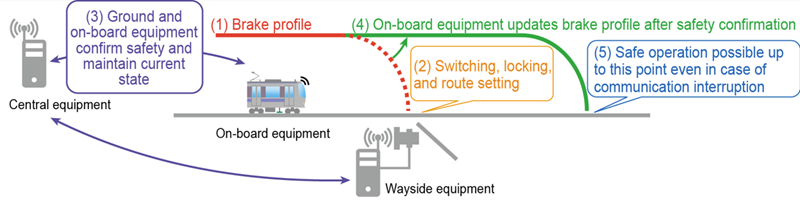
To address this issue, we developed the Safety Confirmation-Based Train Control System that enables safe train operation using common control logic regardless of railway line scale or type of communication network employed. Unlike conventional systems, which stop trains in the event of communication interruption or delays, the proposed system maintains the route setting that is confirmed safe using bidirectional communication between ground and on-board equipment prior to the communication disruption, and preserves the locked status of wayside equipment. Even if communication interruption occurs, train operation safety can be maintained as the system maintains the same state that existed before the disruption (Fig. 1). This enables the use of public communication networks, where communication interruptions and delays must be taken into account.
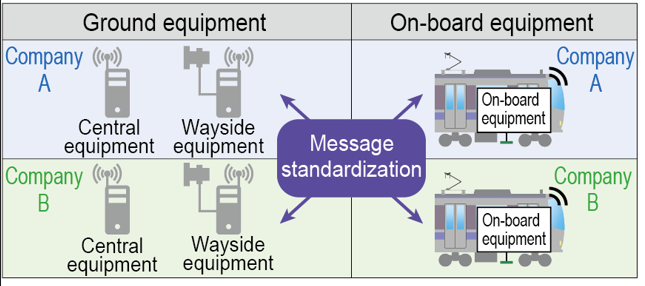
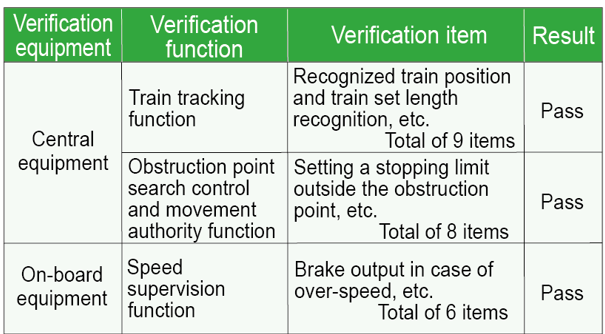
Verification tests of the prototype system on a commercial line confirmed that a test train could be operated safely and stably using public communication networks. Furthermore, by defining the minimum information required for communication between on-board and ground equipment, interoperability was achieved, and tests on a commercial line verified the feasibility of a multi-vendor system (Fig. 2, Table 1).
Based on the results of the verification tests, we proposed a common specification for this system. By introducing equipment based on this specification, maintenance labor can be reduced by reducing communication infrastructure. It can also serve as the train control system foundation for the introduction of automatic train operation on regional railways.
Other Contents
- 7. Fretting Wear Mitigation Method for Axle Journal Bearings
- 8. Construction, Inspection, and Reinforcement Methods for Preventing Fracture of Aluminothermic Weldings
- 9. Rail Head Transverse Crack Detection using Guide Waves
- 10. Automation of Spalling Condition Assessment Using Hammering Sound Judgment AI and Hammer Auto-tracking
- 11. Embankment Quality Control Methods Using Construction Phase Settlement Data
- 12. Damage Estimation and Visualization Tool for Signaling Facilities Affected by Snow Dropping from High-Speed Vehicles
- 13. Marker-Assisted Platform Position Measurement Using Forward-View Train Images
- 14. Anomaly Screening Method for Overhead Contact Line Equipment Requiring High-Frequency Inspection
- 15. Method for Identifying Causes of Failures in Electric Point Machines
- 16. Performance Evaluation Method for Inspection Systems Using Cameras and Sensors Based on CG Simulation
- 17. Method for Constructing 3D Railway Track Spatial Data Using In-service Trains
- 18. Safety Confirmation-Based Train Control System
- 19. Comprehension Visualization System for Trainees in Remote Lectures for Driver Training
- 7. Fretting Wear Mitigation Method for Axle Journal Bearings
- 8. Construction, Inspection, and Reinforcement Methods for Preventing Fracture of Aluminothermic Weldings
- 9. Rail Head Transverse Crack Detection using Guide Waves
- 10. Automation of Spalling Condition Assessment Using Hammering Sound Judgment AI and Hammer Auto-tracking
- 11. Embankment Quality Control Methods Using Construction Phase Settlement Data
- 12. Damage Estimation and Visualization Tool for Signaling Facilities Affected by Snow Dropping from High-Speed Vehicles
- 13. Marker-Assisted Platform Position Measurement Using Forward-View Train Images
- 14. Anomaly Screening Method for Overhead Contact Line Equipment Requiring High-Frequency Inspection
- 15. Method for Identifying Causes of Failures in Electric Point Machines
- 16. Performance Evaluation Method for Inspection Systems Using Cameras and Sensors Based on CG Simulation
- 17. Method for Constructing 3D Railway Track Spatial Data Using In-service Trains
- 18. Safety Confirmation-Based Train Control System
- 19. Comprehension Visualization System for Trainees in Remote Lectures for Driver Training