
19. Comprehension Visualization System for Trainees in Remote Lectures for Driver Training
The classroom training for driver certification lasts several months and may require long-term accommodation at training facilities. Since 2024, remote lectures have been permitted under a notice issued by the Ministry of Land, Infrastructure, Transport and Tourism, and are expected to reduce the burden on trainees. However, no method has existed for quantitatively evaluating the suitability of each subject for remote lectures (i.e., remote affinity). In addition, remote lectures have the issue that instructors find it difficult to grasp trainees' level of understanding.
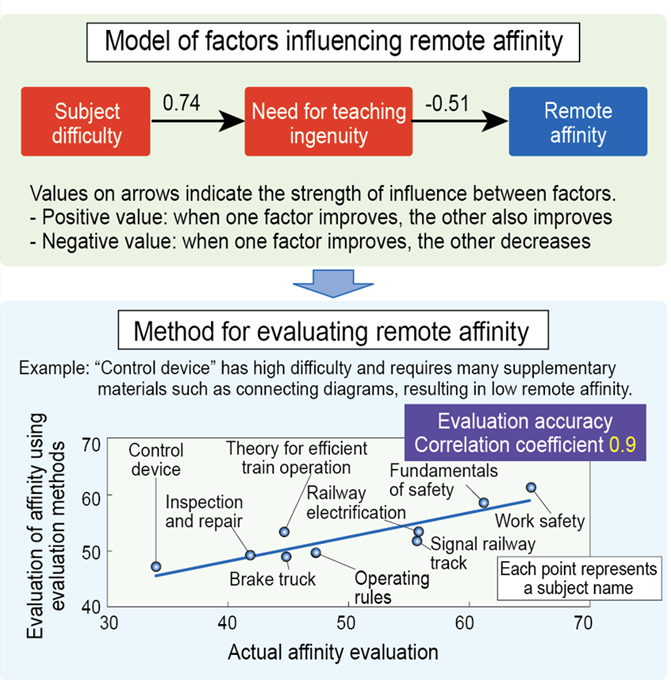
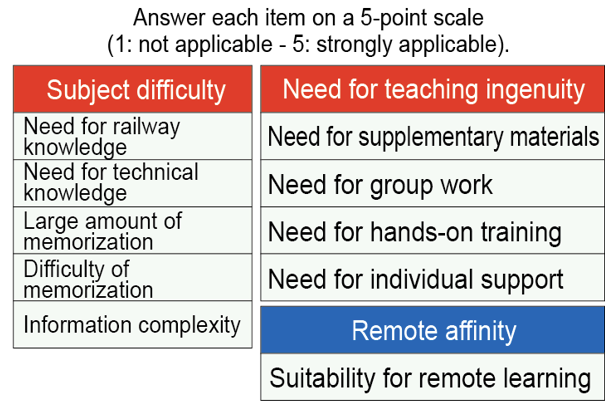
To address this issue, we developed a method for quantitatively evaluating remote affinity based on a survey of 271 trainees (Table 1) and statistical analysis. We then constructed a factor model of remote affinity and found that when the "difficulty" of a subject is high, greater "teaching ingenuity" is required from instructors, and that difficulty in realizing such ingenuity in remote lectures leads to lower remote affinity. Verification using data not used for model construction showed that the accuracy of this evaluation method was 0.9 in terms of the correlation coefficient (Fig. 1).
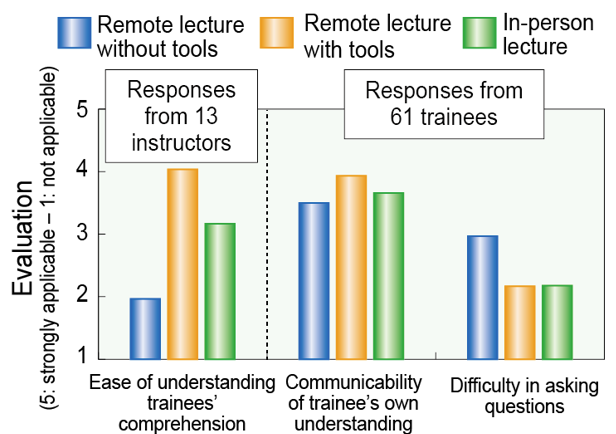
In addition, a system for visualizing learners' comprehension using smartphones was developed. Trainees can submit their level of understanding at any time, allowing instructors to immediately grasp the overall level of understanding of the class. The system implements a method for evaluating remote affinity and can issue early alerts of declining comprehension for subjects with low affinity. In the demonstration experiment, both instructors and trainees reported that it became easier to assess the level of understanding (Fig. 2).
These results can be used to improve the efficiency of railway personnel training through remote lectures.
Other Contents
- 7. Fretting Wear Mitigation Method for Axle Journal Bearings
- 8. Construction, Inspection, and Reinforcement Methods for Preventing Fracture of Aluminothermic Weldings
- 9. Rail Head Transverse Crack Detection using Guide Waves
- 10. Automation of Spalling Condition Assessment Using Hammering Sound Judgment AI and Hammer Auto-tracking
- 11. Embankment Quality Control Methods Using Construction Phase Settlement Data
- 12. Damage Estimation and Visualization Tool for Signaling Facilities Affected by Snow Dropping from High-Speed Vehicles
- 13. Marker-Assisted Platform Position Measurement Using Forward-View Train Images
- 14. Anomaly Screening Method for Overhead Contact Line Equipment Requiring High-Frequency Inspection
- 15. Method for Identifying Causes of Failures in Electric Point Machines
- 16. Performance Evaluation Method for Inspection Systems Using Cameras and Sensors Based on CG Simulation
- 17. Method for Constructing 3D Railway Track Spatial Data Using In-service Trains
- 18. Safety Confirmation-Based Train Control System
- 19. Comprehension Visualization System for Trainees in Remote Lectures for Driver Training
- 7. Fretting Wear Mitigation Method for Axle Journal Bearings
- 8. Construction, Inspection, and Reinforcement Methods for Preventing Fracture of Aluminothermic Weldings
- 9. Rail Head Transverse Crack Detection using Guide Waves
- 10. Automation of Spalling Condition Assessment Using Hammering Sound Judgment AI and Hammer Auto-tracking
- 11. Embankment Quality Control Methods Using Construction Phase Settlement Data
- 12. Damage Estimation and Visualization Tool for Signaling Facilities Affected by Snow Dropping from High-Speed Vehicles
- 13. Marker-Assisted Platform Position Measurement Using Forward-View Train Images
- 14. Anomaly Screening Method for Overhead Contact Line Equipment Requiring High-Frequency Inspection
- 15. Method for Identifying Causes of Failures in Electric Point Machines
- 16. Performance Evaluation Method for Inspection Systems Using Cameras and Sensors Based on CG Simulation
- 17. Method for Constructing 3D Railway Track Spatial Data Using In-service Trains
- 18. Safety Confirmation-Based Train Control System
- 19. Comprehension Visualization System for Trainees in Remote Lectures for Driver Training