
15. Method for Identifying Causes of Failures in Electric Point Machines
Approximately 40% of electric point machine failures that can lead to major transport disorders are sudden failures for which precursors cannot be detected until just before the event. In particular, failures of the electric point machine itself are difficult to identify from appearance, requiring time for investigation and specialized equipment for restoration. As a result, restoration takes a long time and has been a key issue.
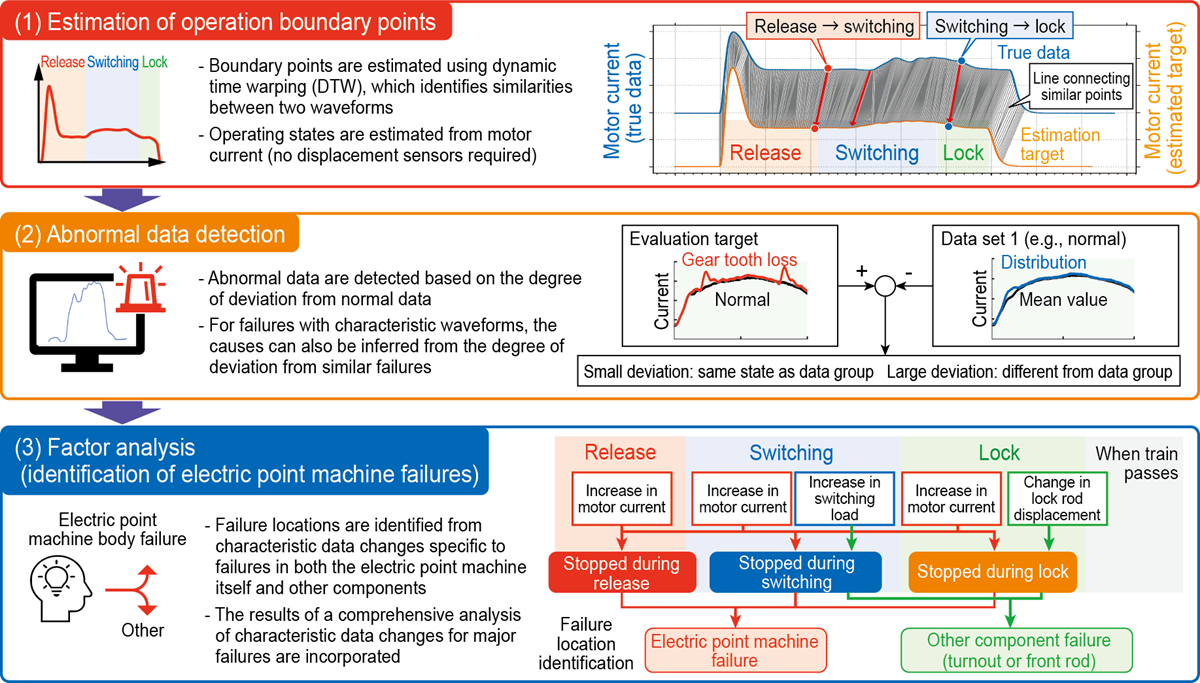
To address this issue, we proposed a method that utilizes data used for preventive maintenance to accelerate breakdown maintenance. Specifically, using remote monitoring data such as motor current, which is used to prevent switching failures, this method enables the identification of failure causes and faulty components immediately after occurrence, even for failures for which no precursors can be detected until just before they occur (Fig. 1).
In this method, (1) boundary points of operation states (e.g., switching and locking) are estimated with high accuracy from motor current (within 0.1-0.3 seconds), (2) failures characterized by distinctive data variations, such as gear tooth loss, are detected based on deviations from pre-trained datasets, and (3) the faulty component is identified as either the electric point machine itself or other components based on characteristic data patterns observed during failures, depending on the operation state of the electric point machine. This method covers the characteristic data variations of major failures (20 types), including sudden failures of the electric point machine itself. In addition, some of the failures were reproduced on an actual machine to verify the validity of the failure identification results. By combining this method with a condition monitoring device, it becomes possible to support the recovery of electric point machine failures, thereby reducing restoration time.
Other Contents
- 7. Fretting Wear Mitigation Method for Axle Journal Bearings
- 8. Construction, Inspection, and Reinforcement Methods for Preventing Fracture of Aluminothermic Weldings
- 9. Rail Head Transverse Crack Detection using Guide Waves
- 10. Automation of Spalling Condition Assessment Using Hammering Sound Judgment AI and Hammer Auto-tracking
- 11. Embankment Quality Control Methods Using Construction Phase Settlement Data
- 12. Damage Estimation and Visualization Tool for Signaling Facilities Affected by Snow Dropping from High-Speed Vehicles
- 13. Marker-Assisted Platform Position Measurement Using Forward-View Train Images
- 14. Anomaly Screening Method for Overhead Contact Line Equipment Requiring High-Frequency Inspection
- 15. Method for Identifying Causes of Failures in Electric Point Machines
- 16. Performance Evaluation Method for Inspection Systems Using Cameras and Sensors Based on CG Simulation
- 17. Method for Constructing 3D Railway Track Spatial Data Using In-service Trains
- 18. Safety Confirmation-Based Train Control System
- 19. Comprehension Visualization System for Trainees in Remote Lectures for Driver Training
- 7. Fretting Wear Mitigation Method for Axle Journal Bearings
- 8. Construction, Inspection, and Reinforcement Methods for Preventing Fracture of Aluminothermic Weldings
- 9. Rail Head Transverse Crack Detection using Guide Waves
- 10. Automation of Spalling Condition Assessment Using Hammering Sound Judgment AI and Hammer Auto-tracking
- 11. Embankment Quality Control Methods Using Construction Phase Settlement Data
- 12. Damage Estimation and Visualization Tool for Signaling Facilities Affected by Snow Dropping from High-Speed Vehicles
- 13. Marker-Assisted Platform Position Measurement Using Forward-View Train Images
- 14. Anomaly Screening Method for Overhead Contact Line Equipment Requiring High-Frequency Inspection
- 15. Method for Identifying Causes of Failures in Electric Point Machines
- 16. Performance Evaluation Method for Inspection Systems Using Cameras and Sensors Based on CG Simulation
- 17. Method for Constructing 3D Railway Track Spatial Data Using In-service Trains
- 18. Safety Confirmation-Based Train Control System
- 19. Comprehension Visualization System for Trainees in Remote Lectures for Driver Training