
14. Anomaly Screening Method for Overhead Contact Line Equipment Requiring High-Frequency Inspection
To reduce labor costs in OCL maintenance, initiatives are underway to replace on-foot patrols with vehicle-captured image inspection, and a method has already been developed to screen anomalies from a large volume of vehicle-captured images of fittings attached to the contact wire. However, extending this method to every OCL equipment requiring high-frequency inspection, including equipment with more complex geometries and inspection cycles within one year, required addressing missed detections of localized anomalies and false detections caused by background objects.
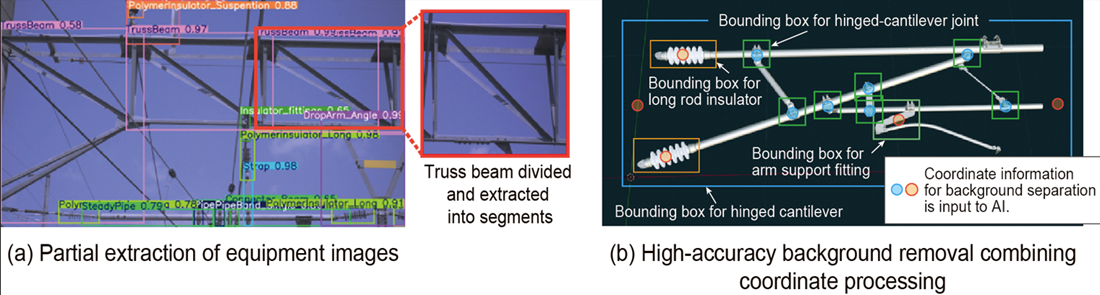
To address these issues, we proposed a method that improves anomaly screening accuracy by applying RTRI's original preprocessing to input images before the anomaly detection process. This preprocessing includes region cropping tailored to the distinctive geometries of overhead contact line equipment (Fig. 1 (a)), aspect ratio adjustment, and high-accuracy background removal combining coordinate processing with AI (Fig. 1 (b)). The method is also applicable to equipment such as hinged cantilevers, beams, insulators, and mid-point anchors.
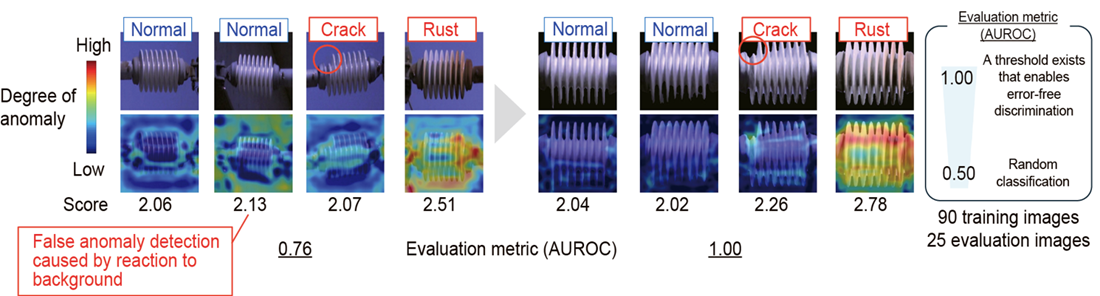
For example, for insulators, we created synthetic images reproducing anomalies based on images captured from conventional line vehicles, and evaluated the anomaly screening performance using AUROC, a metric that comprehensively assesses discrimination performance across varying thresholds, with the score improving from 0.76 to 1.00 (Fig. 2).
This method enables expansion of the OCL equipment subject to anomaly screening and streamlines the work of engineers checking anomalous images.
Other Contents
- 7. Fretting Wear Mitigation Method for Axle Journal Bearings
- 8. Construction, Inspection, and Reinforcement Methods for Preventing Fracture of Aluminothermic Weldings
- 9. Rail Head Transverse Crack Detection using Guide Waves
- 10. Automation of Spalling Condition Assessment Using Hammering Sound Judgment AI and Hammer Auto-tracking
- 11. Embankment Quality Control Methods Using Construction Phase Settlement Data
- 12. Damage Estimation and Visualization Tool for Signaling Facilities Affected by Snow Dropping from High-Speed Vehicles
- 13. Marker-Assisted Platform Position Measurement Using Forward-View Train Images
- 14. Anomaly Screening Method for Overhead Contact Line Equipment Requiring High-Frequency Inspection
- 15. Method for Identifying Causes of Failures in Electric Point Machines
- 16. Performance Evaluation Method for Inspection Systems Using Cameras and Sensors Based on CG Simulation
- 17. Method for Constructing 3D Railway Track Spatial Data Using In-service Trains
- 18. Safety Confirmation-Based Train Control System
- 19. Comprehension Visualization System for Trainees in Remote Lectures for Driver Training
- 7. Fretting Wear Mitigation Method for Axle Journal Bearings
- 8. Construction, Inspection, and Reinforcement Methods for Preventing Fracture of Aluminothermic Weldings
- 9. Rail Head Transverse Crack Detection using Guide Waves
- 10. Automation of Spalling Condition Assessment Using Hammering Sound Judgment AI and Hammer Auto-tracking
- 11. Embankment Quality Control Methods Using Construction Phase Settlement Data
- 12. Damage Estimation and Visualization Tool for Signaling Facilities Affected by Snow Dropping from High-Speed Vehicles
- 13. Marker-Assisted Platform Position Measurement Using Forward-View Train Images
- 14. Anomaly Screening Method for Overhead Contact Line Equipment Requiring High-Frequency Inspection
- 15. Method for Identifying Causes of Failures in Electric Point Machines
- 16. Performance Evaluation Method for Inspection Systems Using Cameras and Sensors Based on CG Simulation
- 17. Method for Constructing 3D Railway Track Spatial Data Using In-service Trains
- 18. Safety Confirmation-Based Train Control System
- 19. Comprehension Visualization System for Trainees in Remote Lectures for Driver Training